
10 Best Microsoft Copilot Alternatives in 2026
Looking for a Copilot alternative that runs HR and IT workflows — not just answers questions? Compare top options, pricing, and deployment times.


TL;DR
Microsoft Copilot improves productivity, but lacks the depth needed for end-to-end enterprise workflow automation across IT and HR.

Many organizations seek alternatives due to limitations in customization, accuracy for complex queries, and ecosystem lock-in within Microsoft 365.
Modern enterprises need AI platforms that go beyond assistance to automate workflows, integrate systems, and deliver measurable ROI.
Tools like Workativ stand out by enabling action-driven AI agents that resolve requests, not just generate responses.
Microsoft Copilot brought generative AI into everyday work by embedding assistance across Microsoft 365 apps. It positioned AI as a productivity layer for writing, summarizing, and searching especially for organizations already locked into the Microsoft ecosystem.
However, even Satya Nadella has openly acknowledged that early Copilot adoption has shown AI alone does not automatically translate into business outcomes. In multiple interviews, he emphasized that productivity gains depend on workflow redesign, system integration, and real operational change—not just AI features layered on top of existing tools.
This gap is exactly why many enterprises are now searching for Microsoft Copilot alternatives.
Organizations need more than an AI assistant for documents and meetings. They are looking for platforms that can automate IT and HR workflows, resolve employee requests end-to-end, integrate with service management systems, and deliver measurable ROI, areas where Copilot’s scope remains limited.
In this guide, we evaluate the best Microsoft Copilot alternatives in 2026, comparing enterprise AI platforms built for automation, governance, and employee support at scale—starting with Workativ, a leading platform designed specifically for real-world enterprise workflow.
What buyers really want from a Microsoft Copilot alternative in 2026
Most teams do not look for a Microsoft Copilot alternative because they need another AI writing assistant. They look for one because their day-to-day business needs go beyond drafting documents, summarizing meetings, or searching across Microsoft 365.
For HR, IT, operations, and employee support teams, the bigger challenge is resolution. Employees need quick answers to policy questions, help with access requests, support for IT issues, updates on tickets, guidance during onboarding, and assistance with everyday workplace tasks. These requests often depend on systems outside Microsoft 365, such as HRIS platforms, ITSM tools, knowledge bases, ticketing systems, identity tools, and communication channels.
That is where many teams start comparing Microsoft Copilot with AI agent platforms. Copilot is useful when employees need productivity support inside Microsoft apps. But when the goal is to reduce repetitive tickets, automate internal workflows, connect multiple business systems, and hand off complex requests to the right team, companies need a different kind of solution.
The real question for buyers is no longer:
“Which AI assistant helps employees work faster?”
It is:
“Which AI platform helps our support teams resolve more employee requests with less manual effort?”
This is why Microsoft Copilot alternatives are often evaluated on practical business outcomes: faster employee response times, fewer repeated HR and IT questions, stronger system integrations, better workflow automation, clearer ownership, and measurable ROI from reduced support workload.
For companies that want AI to move beyond assistance and into action, an AI agent platform can be a better fit than a general-purpose productivity copilot.
Microsoft Copilot is useful, but it is not always enough for employee support
Microsoft Copilot works well when the goal is to help an individual employee be more productive. It can summarize a Teams meeting, draft an email, analyze a spreadsheet, or help someone find information across Microsoft 365.
Employee support works differently.
HR and IT teams are not only trying to help one employee complete one task faster. They are trying to manage hundreds or thousands of repeated requests across the company: policy questions, leave queries, access issues, onboarding tasks, payroll doubts, ticket updates, device requests, and approval workflows.
These requests need more than content generation. They need context, ownership, system access, workflow routing, and a clear path to resolution. For example, answering “How do I request parental leave?” is useful. But a support-ready AI agent should also guide the employee through the next step, check the right policy source, capture required details, route approvals, create or update a ticket, and hand off the case when human review is needed.
That is the gap many teams notice when they compare Microsoft Copilot with AI agent platforms. Copilot improves how people work inside Microsoft apps. An AI agent platform improves how support teams resolve work across systems.
For companies trying to reduce repetitive employee tickets, shorten response times, and automate HR or IT workflows, the buying decision is less about finding another copilot and more about choosing a platform that can turn employee questions into completed support outcomes.
Why look for an alternative to Microsoft Copilot
While Microsoft Copilot improves individual productivity inside Word, Excel, Outlook, and Teams, many organizations find it insufficient for enterprise-scale automation. Copilot primarily operates as an AI assistant layered on top of Microsoft 365, limiting its ability to resolve real employee requests end-to-end. Let’s explore the challenges Microsoft Copilot poses for users.
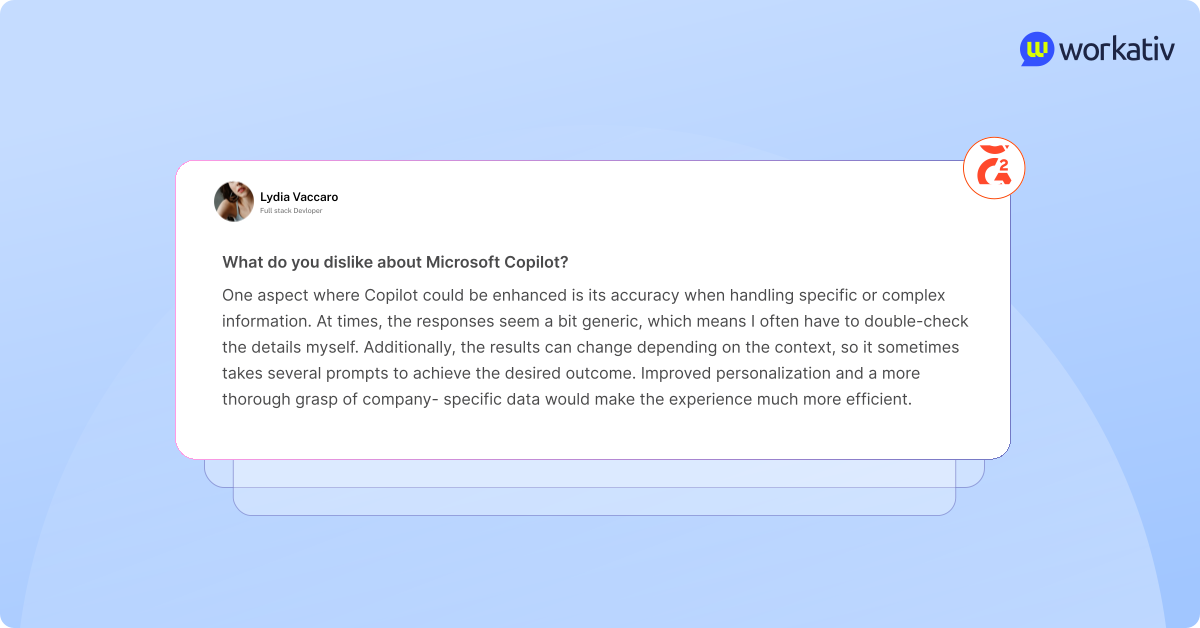
Limited accuracy for complex and company-specific queries : Microsoft Copilot works well for general assistance, but users often report that responses become generic or unreliable when dealing with complex, domain-specific information. This forces employees to verify details, which reduces trust and slows workflows. Enterprises handling IT, HR, or policy-driven queries need AI systems that deeply understand internal context not just surface-level summaries.
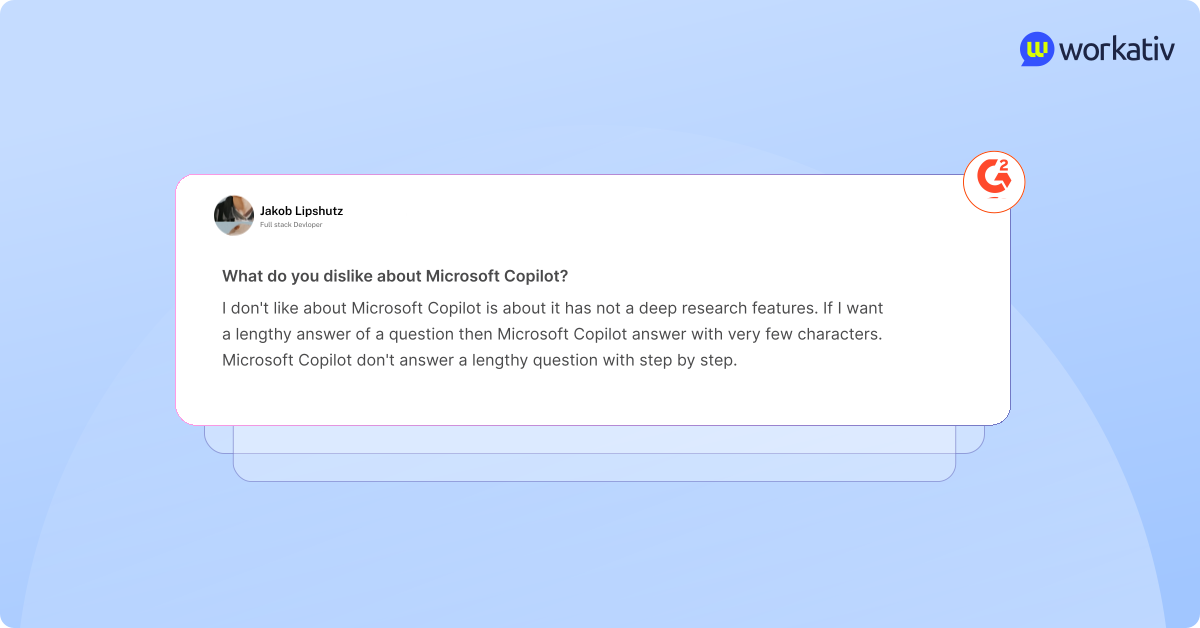
Microsoft Copilot lacks deep research for multi-turn questions : It is observed that Microsoft Copilot lacks deep research capabilities. When asked lengthy or detailed questions, Copilot responds with very few characters rather than a comprehensive explanation. It also does not answer complex questions step by step, which makes it less effective for in-depth understanding or detailed problem-solving.
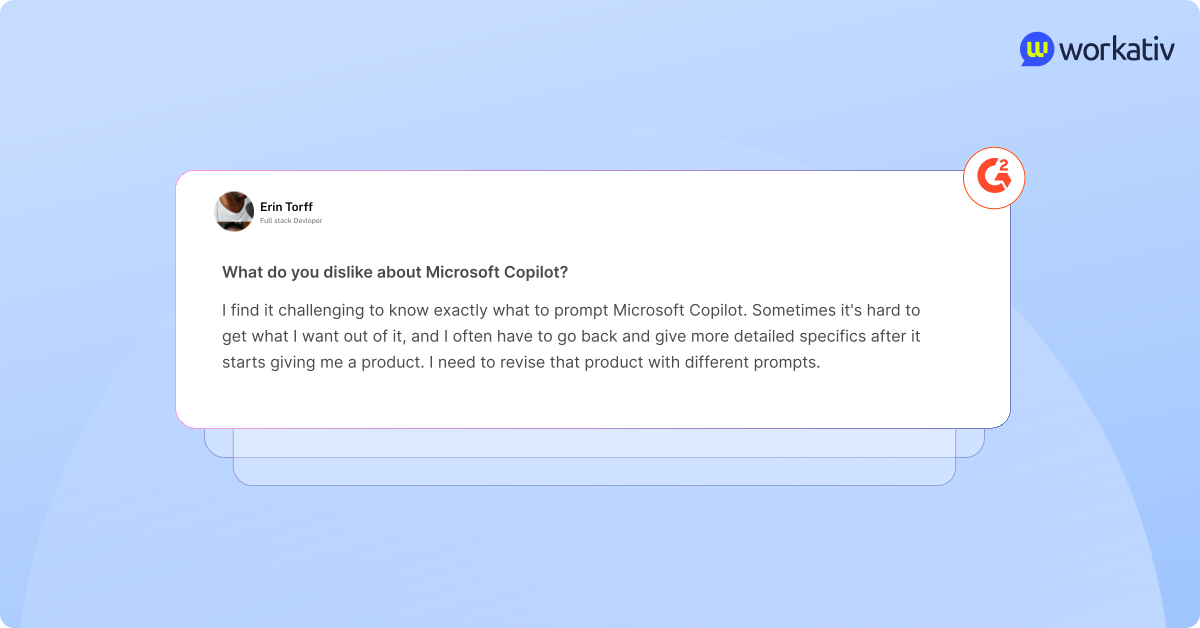
Repeated prompting is required for the desired output : The reviewer finds it challenging to know exactly how to prompt Microsoft Copilot. They often struggle to get the desired result on the first attempt and need to go back and add more detailed instructions. This leads to revising the same output multiple times using different prompts, which makes the experience less efficient.
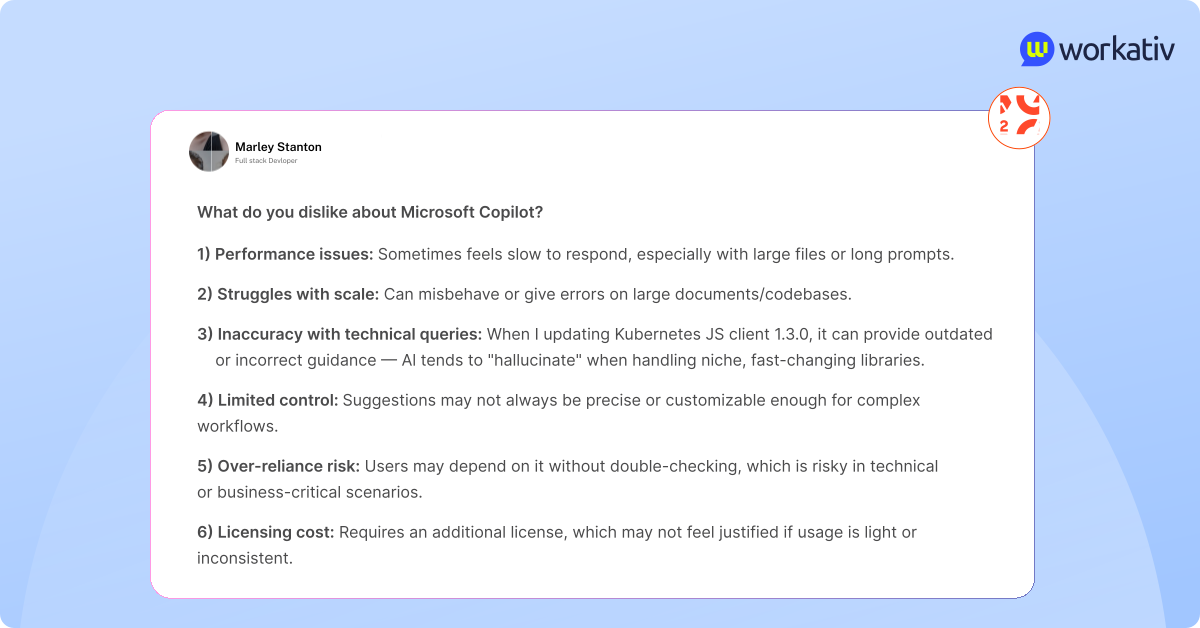
Performance, accuracy, control, and cost limitations : There are multiple concerns with Microsoft Copilot, including slow performance with large files, errors when working at scale, and inaccurate guidance for technical or fast-changing libraries. They also note limited control over outputs for complex workflows and the risk of over-reliance without proper verification. Additionally, the requirement for an extra license raises cost concerns, especially when usage is light or inconsistent.
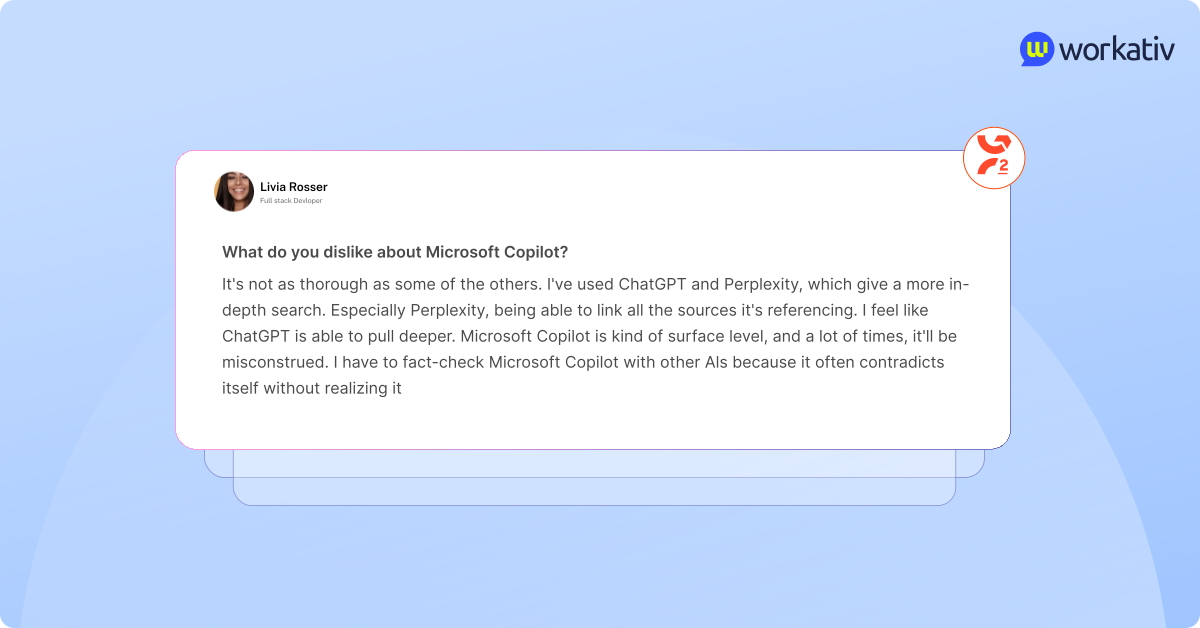
Surface-level answers and inconsistent accuracy : The reviewer feels that Microsoft Copilot is not as thorough as other AI tools and tends to provide surface-level responses. Compared to tools like ChatGPT and Perplexity, Copilot does not pull information as deeply or clearly reference sources. They also mention having to frequently fact-check Copilot because responses can be misconstrued or contradict themselves without notice. Besides, there are significant challenges with Microsoft Copilot.
Ecosystem dependency on Microsoft 365 : Microsoft Copilot works best only within the Microsoft 365 ecosystem, limiting flexibility for organizations that rely on multiple tools. This creates vendor lock-in and reduces the ability to build cross-platform workflows.
Limited customization for ITSM, HR, and internal workflows : Copilot is designed for productivity assistance, not deep workflow customization. It lacks the flexibility needed to tailor IT, HR, and internal support processes end-to-end.
High licensing costs at scale : Copilot requires additional per-user licensing, which can become expensive as adoption grows. For organizations with large employee bases, cost often outweighs the value delivered.
Data governance and tenant-level control concerns : Enterprises have limited visibility and control over how data is accessed and contextualized across tenants. This raises concerns around governance, auditability, and compliance in regulated environments.
Beyond Microsoft Co-pilot
AI that actually resolves requests - not just suggests. See how Workativ automates your employee support end-to-end
Personalized demo · No commitment · Setup in Mins
See Workativ AI in action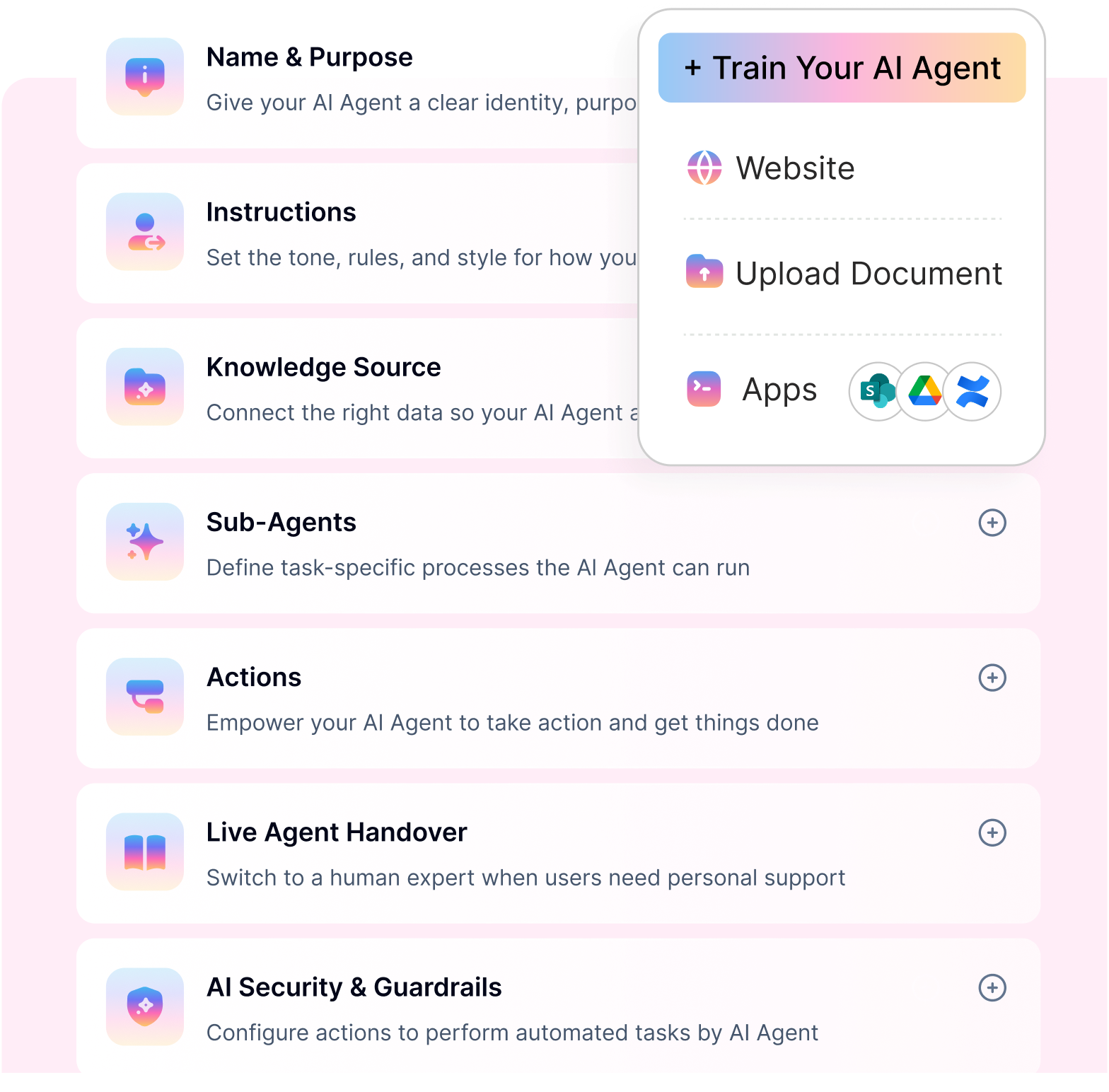
Microsoft Copilot pricing and ROI: why teams compare alternatives
Pricing becomes a bigger question when Microsoft Copilot moves from a small pilot to a company-wide rollout.
Copilot can help employees work faster inside Microsoft 365. It can support tasks like:
summarizing meetings
drafting emails
creating documents
searching workplace content
improving day-to-day productivity
But for enterprise buyers, productivity alone is not always enough.
The bigger question is:
What measurable business outcome does this AI investment create?
For HR, IT, and employee support teams, ROI usually needs to be tied to operational impact, such as:
fewer repetitive tickets
faster employee responses
reduced manual workload
better self-service adoption
more requests resolved without human intervention
That is why many teams compare Copilot with AI agent platforms built for support automation.
Workativ fits this use case because it connects AI spend to clear support outcomes. Employees can ask questions in Slack, Microsoft Teams, or web chat and get answers from approved company knowledge.
They can also complete real support actions, such as:
creating a ticket
checking request status
triggering approvals
submitting HR or IT requests
escalating complex issues to a human agent
This makes ROI easier to explain.
Instead of only saying employees may save time across documents and meetings, teams can show how AI reduces support volume, speeds up resolution, and helps HR and IT teams handle more requests without adding headcount.
So the pricing question should not only be:
Which AI tool costs less?
It should be:
Which AI platform creates value we can actually measure?
If the goal is Microsoft 365 productivity, Copilot can be useful. But if the goal is to automate employee support, reduce manual HR and IT work, and resolve more internal requests end-to-end, Workativ gives teams a clearer ROI story.
TL;DR: Microsoft Copilot alternatives at a glance
Name | Ratings | Pricing | Key features | Pros and cons |
Workativ | ⭐⭐⭐⭐⭐ (4.7/5) | Custom (enterprise) | AI agents for HR & IT, action-based automation, LLM reasoning, Slack & Teams native | Pros: Deep automation beyond HR, strong AI reasoning, flexible integrations. Cons: Enterprise onboarding effort |
Moveworks | ⭐⭐⭐⭐☆ (4.5/5) | Enterprise-only | IT service automation, employee self-service, NLP | Pros: Strong ITSM use cases. Cons: High cost, limited HR depth |
Aisera | ⭐⭐⭐⭐ (4.3/5) | Enterprise | AI service desk, IT & HR automation | Pros: Broad IT focus. Cons: Complex setup, UI learning curve |
Espressive | ⭐⭐⭐⭐ (4.4/5) | Custom | HR virtual assistant, employee knowledge base | Pros: HR-first design. Cons: Limited cross-functional expansion |
Leena AI | ⭐⭐⭐⭐☆ (4.5/5) | Subscription-based | HR automation, employee self-service, workflow orchestration | Pros: Strong HR workflows, intuitive UX. Cons: Limited depth beyond HR use cases |
Copilot Studio alternatives: when teams need simpler AI agent building
Some teams are not only comparing Microsoft 365 Copilot. They are also looking for better ways to build AI agents.
That is where Copilot Studio alternatives come into the conversation.
Copilot Studio can help teams create agents within the Microsoft ecosystem. But not every business wants to build only around Microsoft tools. Many HR, IT, and employee support teams need agents that can work across different systems, channels, and workflows.
For example, they may need an AI agent that can:
answer from approved company knowledge
connect with HRIS, ITSM, and identity tools
create or update support tickets
trigger approvals and internal workflows
work inside Slack, Microsoft Teams, or web chat
hand off complex requests to a human agent
This is why teams often look for alternatives to Copilot Studio when they need more flexibility, simpler setup, or stronger workflow automation across HR and IT.
Workativ fits this need with its no-code AI Agent Studio. Teams can build HR and IT support agents, connect enterprise knowledge, add workflow actions, and deploy agents across the channels employees already use.
The difference is practical.
Instead of building an agent that only answers questions, Workativ helps teams build agents that can resolve requests.
An employee can ask a policy question, check ticket status, submit a request, trigger an approval, or get routed to a human agent when needed — all from one conversational experience.
For teams that want an AI agent builder alternative to Microsoft Copilot Studio, Workativ is a strong fit because it combines no-code agent building, enterprise knowledge, integrations, workflow automation, and human handoff in one platform.
Top Microsoft Copilot alternatives in 2026
As enterprises move beyond AI-powered productivity toward real workflow automation, many teams are reassessing Microsoft Copilot’s limitations around customization, cost, and enterprise control. The platforms below represent the top Microsoft Copilot alternatives in 2026, offering deeper automation, stronger governance, and purpose-built AI for HR, IT, and internal support use cases.
Workativ

Workativ is an enterprise AI agent and automation platform that helps organizations automate employee and customer interactions across HR, IT, and internal support. Instead of acting as a simple chatbot, Workativ enables action-driven AI agents that understand intent, retrieve knowledge, and complete tasks end-to-end—directly from Slack, Microsoft Teams, and web chat.
Key capabilities include AI Agent Studio, advanced RAG with multi-knowledge sourcing, AI actions for workflow execution, shared live inbox, multichannel deployment, multilingual support (90+ languages), and enterprise-grade security (SOC 2 Type II, GDPR). This makes Workativ ideal for mid-market and enterprise teams looking for real automation, not just AI-powered responses.
Workativ goes beyond productivity assistance by enabling AI agents that reason, take action, and resolve HR and IT workflows end-to-end, not just suggest or summarize information.
Most important features and who they benefit
Workativ is ideal for mid-market and large enterprises that want to consolidate HR and IT support into a single AI layer. Workativ offers,
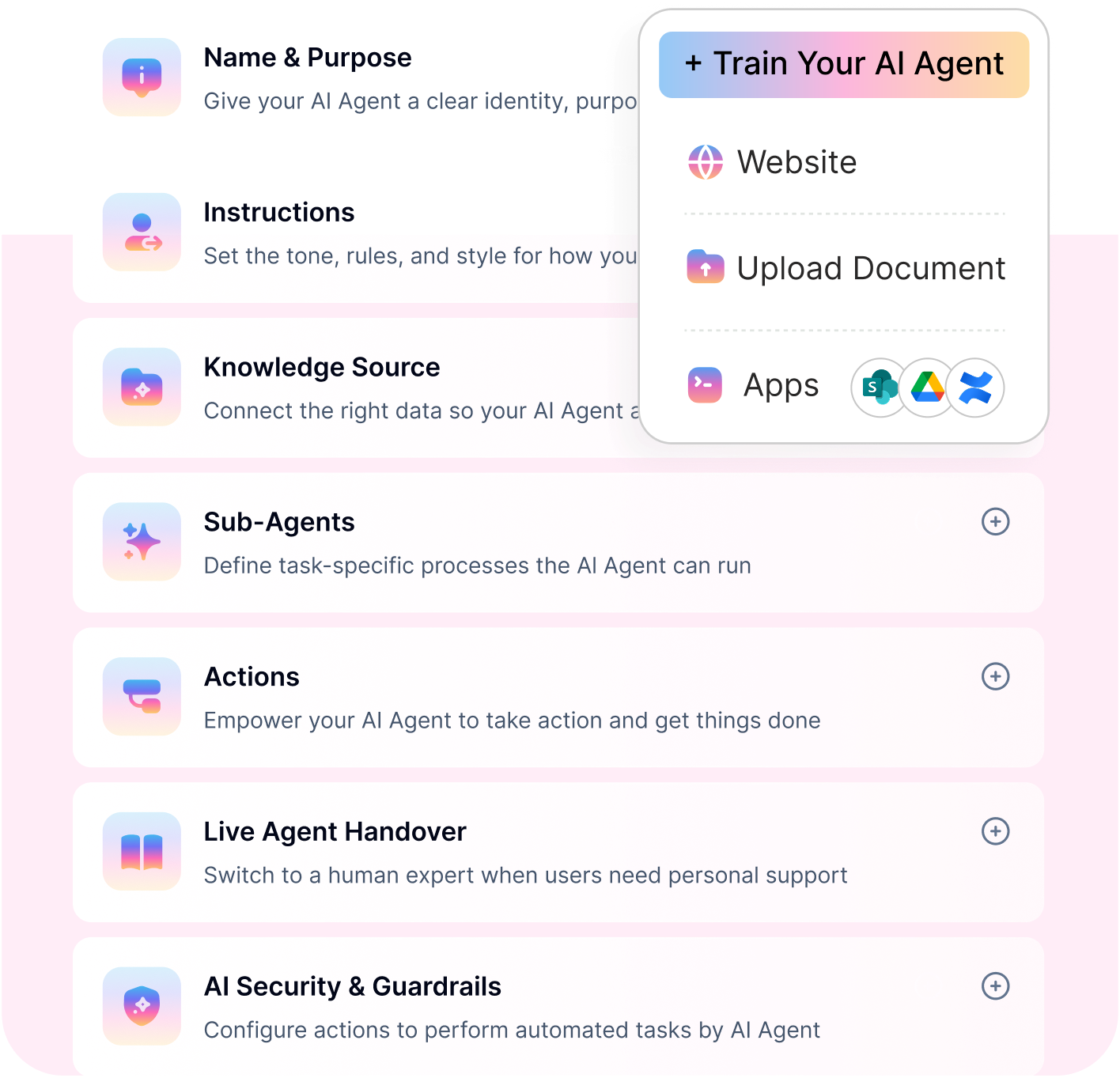
AI Agent Studio enables IT and HR teams to build, train, and deploy AI agents without code, reducing reliance on engineering resources.
AI actions and workflow automation allow AI agents to execute real tasks such as ticket creation, approvals, and system updates, delivering true end-to-end resolution.
Advanced RAG with multi-knowledge sourcing ensures employees receive accurate, context-aware responses by pulling information from multiple enterprise knowledge bases.
Shared live inbox and multichannel support help support teams manage AI and human conversations centrally across Slack, Microsoft Teams, and web chat.
Multilingual support across 90+ languages benefits global organizations by providing consistent employee and customer experiences across regions.
Enterprise-grade security and AI guardrails support regulated businesses with built-in compliance, data protection, and AI governance controls.
Value proposition
Workativ’s value proposition lies in its automation-first approach to enterprise AI. Unlike productivity tools that provide suggestions or summaries, Workativ enables AI agents to understand intent, reason through requests, and take action across systems. This allows organizations to resolve HR and IT requests end to end, reduce manual effort, and achieve measurable operational ROI—while maintaining enterprise-grade security, governance, and control.
Key features of Workativ
No-code AI Agent Studio: Workativ’s no-code AI Agent Studio enables teams to design, configure, and deploy AI agents for HR and IT use cases without development effort, significantly reducing implementation time and accelerating time-to-value.
Extensive knowledge and data source connectors: Workativ seamlessly connects with enterprise knowledge sources such as SharePoint, Google Drive, OneDrive, Box, Confluence, Notion, ServiceNow, and Freshservice, enabling AI agents to deliver responses grounded in up-to-date internal information.
Workflow automation across enterprise systems: Workativ AI agents integrate with core enterprise tools to automate end-to-end multi-step employee and IT workflows, including request creation, approvals, updates, and system actions.
Advanced RAG for accurate, context-aware responses: Workativ uses advanced retrieval-augmented generation (RAG) to ground AI responses in enterprise knowledge sources such as HR policies, IT documentation, and internal systems, reducing hallucinations and improving answer reliability.
Shared live chat inbox: Workativ offers a unified inbox where human agents can monitor AI conversations, collaborate internally, and seamlessly take over interactions without losing context.
Pre-built AI agent templates: Workativ provides industry-ready AI agent templates for IT, HR, and operational use cases, enabling organizations to launch production-grade agents quickly with minimal configuration.
Multichannel deployment: AI agents built on Workativ can be deployed across Slack, Microsoft Teams, web portals, and internal communication channels, ensuring employees can access support wherever they work.
Enterprise-grade AI security and guardrails: Workativ enforces robust AI safety controls, including PII and sensitive data redaction, prompt injection protection, secrets and token masking, profanity filtering, and compliance-ready guardrails.
Multilingual platform for global audiences: With out-of-the-box language detection and translation across 90+ languages, Workativ enables enterprises to support global workforces with consistent, localized AI interactions.
White-label flexibility: Workativ allows organizations to fully rebrand their AI agents by customizing logos, colors, and UI to match their brand identity—without additional licensing or add-on costs.
Action-driven automation beyond question answering: Workativ’s AI agents can trigger real actions—such as creating tickets, submitting requests, updating records, or initiating approvals—allowing employee issues to be resolved end to end within a single interaction.
Pros:
Integrated AI-driven automation: Workativ automates repetitive HR and IT support queries, resolving a large share of employee requests without human intervention from a single platform.
Easy to adopt and use: Designed with an intuitive interface that requires minimal learning, enabling faster adoption across business and support teams.
Extensive enterprise integrations: Workativ integrates with 100+ enterprise tools across ITSM, HRMS, access management, email, and expense systems to automate workflows end-to-end.
Multi-agent architecture for complex workflows: Workativ uses a multi-agent reasoning engine to break down and execute multi-step processes reliably, reducing errors and hallucinations.
AI reasoning visibility (AI Thoughts): Workativ AI agents provide transparent reasoning and traceability behind AI responses, improving observability and trust in automated decisions.
Advanced insights and analytics: Get customizable dashboards for tracking AI performance, query trends, topic analysis, and optimization opportunities.
Enterprise-grade security and compliance: Built with ISO 27001, SOC 2, GDPR, and enterprise security controls to safeguard sensitive internal data.
Cost-effective for enterprise use cases: Workativ delivers high-performance AI automation at a more affordable price point than many enterprise platforms, with a starter plan available to evaluate core capabilities.
Cons:
May be perceived as “SMB product” by some enterprises: Workativ’s affordable pricing and free entry plan can sometimes be perceived as a budget-tier solution by enterprise buyers who associate higher price points with premium positioning.
Advanced AI analytics available in higher tiers: While core AI capabilities are included across plans, more advanced analytics, deeper insights, and enhanced AI performance dashboards are available only in the Business and Enterprise tiers.
Ratings
Workativ is consistently rated highly by users for its depth of automation, ease of integration, and ability to handle both HR and IT support use cases from a single platform.
G2: ⭐⭐⭐⭐⭐ (4.8/5)
Capterra: ⭐⭐⭐⭐☆ (4.5/5)
Gartner Peer Insights: Positive feedback for AI-driven service automation and workflow execution
Pricing:
Workativ offers transparent, tiered pricing that scales from pilots to enterprise deployments.
Starter Plan $99/month : Including 1 AI agent, up to 200 AI chat sessions, analytics, shared live inbox, and security guardrails.
Business Plan $349/month : Designed for growing teams with higher chat limits, multiple AI agents, workflow actions, advanced analytics, and branding removal.
Enterprise Plan Custom pricing : Built for large organizations requiring higher scale, advanced security, custom integrations, RBAC, MFA, and dedicated support.
Overall, Workativ offers a more cost-effective, transparent pricing model than enterprise-only platforms like Leena AI.
Why choose Workativ over Microsoft Copilot?
Workativ is designed for organizations that need AI to resolve work, not just assist with it, addressing the exact gaps that teams encounter with Microsoft Copilot.
Built for automation, not ecosystem lock-in : While Microsoft Copilot works primarily inside Microsoft 365, Workativ operates across tools and systems, enabling cross-platform workflows without forcing organizations into a single ecosystem.
Purpose-built for HR, IT, and internal workflows : Copilot focuses on productivity tasks like writing and summarization, whereas Workativ is built to automate ITSM, HR requests, approvals, and internal support processes end-to-end.
Predictable value at scale : Copilot’s per-user add-on licensing can become costly as adoption grows, while Workativ’s enterprise pricing is aligned to automation outcomes and usage, making ROI easier to justify at scale.
Stronger governance and control : Workativ offers enterprise-grade controls, including AI guardrails, role-based access, auditability, and knowledge-level governance, giving organizations greater confidence in regulated environments.
From answers to actions : Most importantly, Workativ connects AI reasoning directly to real actions creating tickets, triggering workflows, and updating systems eliminating the repeated prompting and manual follow-ups commonly required with Microsoft Copilot.
If Microsoft Copilot feels limited to assisting work within documents and meetings, Workativ is the better choice for enterprises that want AI-driven automation, control, and measurable operational impact.
Workativ vs Microsoft Copilot: feature-level comparison
Feature | Workativ | Microsoft Copilot |
Core focus | End-to-end AI automation for HR, IT, and internal support | AI productivity assistance within Microsoft 365 |
AI agent creation | No-code AI Agent Studio to build, train, and deploy task-driven agents | Not supported (no custom agent orchestration for workflows) |
Workflow execution | AI agents can take actions such as ticket creation, approvals, and system updates | Limited to suggestions and assistance, no native task execution |
ITSM & HR automation | Purpose-built for ITSM, HR workflows, and employee self-service | Not purpose-built for ITSM or HR workflows |
Advanced RAG | Enterprise-grade RAG with controlled, multi-source knowledge retrieval | Limited control over retrieval and grounding |
AI that actually resolves
Automate your employee support helpdesk with Workativ, no code needed.
Personalized demo · No commitment · Deploy in Mins
See Live DEMO in actionMoveworks

Moveworks is a Microsoft Copilot alternative focused on enterprise employee experience and IT automation. It uses conversational AI and NLP to resolve employee issues related to IT, HR, and workplace services. The platform integrates deeply with ITSM tools and enterprise systems to automate common requests. Moveworks is widely adopted by large enterprises aiming to reduce ticket volume and improve employee self-service.
Key features:
AI-powered employee support: Uses conversational AI and NLP to understand employee intent and automate IT support interactions.
Deep ITSM integrations: Integrates with platforms like ServiceNow to enable automated ticket creation, routing, and resolution.
Employee experience automation: Centralizes IT and limited HR support into a single AI-driven employee assistance layer.
Pros:
Strong ITSM automation: Delivers reliable automation for high-volume IT support use cases in large organizations.
Enterprise scalability: Built to support global enterprises with large employee populations.
Cons:
High enterprise pricing: Cost can be prohibitive for mid-market or growing organizations.
Limited HR and cross-functional depth: Primarily optimized for IT use cases rather than full HR or operations automation.
Pricing:
Enterprise plan - Custom pricing
Moveworks does not publish standard pricing and follows a demo-led, enterprise sales model. Pricing typically depends on organization size, number of employees, integrations (ITSM, HRIS, IAM), and support requirements.
Industry reports and customer feedback often place Moveworks’ annual cost at ~$200,000 to $1M+, making it suitable primarily for large enterprises.
No free plan
No self-serve trial
Ratings:
G2: ⭐⭐⭐⭐☆ (4.5/5)
Aisera

Aisera is a Microsoft Copilot alternative focused on AI-driven IT service management (ITSM) and enterprise service automation. It uses conversational AI and machine learning to automate IT, HR, and customer support requests. The platform is positioned for enterprises that want to reduce ticket volume through AI self-service. Organizations with complex IT environments and high support demand commonly adopt Aisera.
Key features:
AI service desk automation: Uses NLP and intent detection to resolve IT and employee support requests without human intervention.
ITSM and enterprise integrations: Integrates with platforms like ServiceNow, BMC, and Jira to automate ticket creation, routing, and resolution.
Analytics and AI insights: Provides dashboards to track deflection rates, resolution time, and AI performance across service workflows.
Pros:
Broad IT automation focus: Strong capabilities for IT-heavy environments with large ticket volumes.
Enterprise-ready platform: Designed to support complex workflows and large-scale deployments.
Cons:
Complex setup and configuration: Implementation can require significant time and expertise.
Steeper learning curve: UI and configuration may feel less intuitive for non-technical teams.
Pricing:
Enterprise plan - Custom pricing : Aisera does not publish standard pricing and follows a demo-led enterprise sales model. Pricing varies based on organization size, number of automated use cases, integrations, and support scope. It is generally positioned for mid-market and large enterprises, with costs scaling as AI automation depth increases.
Ratings:
G2: ⭐⭐⭐⭐☆ (4.4/5)
Espressive

Espressive is a Microsoft Copilot alternative built for employee self-service and HR-focused automation. It uses conversational AI to help employees quickly find answers to policy, benefits, and workplace questions. The platform is centered around a curated knowledge base rather than deep workflow execution. Espressive’s Barista is commonly used by enterprises looking to improve HR support efficiency and employee experience.
Key features:
HR virtual assistant: Delivers AI-powered answers to employee questions related to HR policies, benefits, and workplace information.
Knowledge base-driven responses: Uses structured enterprise knowledge to provide consistent and approved answers.
Employee self-service automation: Reduces HR ticket volume by enabling employees to resolve common questions on their own.
Pros:
Strong HR-first experience: Well-suited for organizations prioritizing HR knowledge delivery and employee FAQs.
Easy employee adoption: Conversational interface makes it simple for employees to get answers quickly.
Cons:
Limited workflow automation: Focuses more on answering questions than executing end-to-end actions.
Less flexibility beyond HR: Not ideal for complex IT or cross-functional automation needs.
Pricing:
Enterprise plan - Custom pricing : Espressive follows a quote-based enterprise pricing model with costs depending on employee count, integrations, and support scope. Pricing details are not publicly disclosed, and the platform is typically targeted at large organizations.
Ratings:
G2: ⭐⭐⭐⭐⭐ (4.9/5)
Rezolve AI

Rezolve AI positions itself as a Microsoft Copilot alternative for organizations seeking conversational AI layered on internal support systems. It focuses on enabling employees to get help through chat-driven experiences across IT and HR. The platform emphasizes configurability, allowing teams to adapt AI conversations to internal processes. Rezolve AI is often chosen by enterprises seeking conversational self-service without rebuilding their existing support stack.
Key features:
Conversational AI for employee support: Uses NLP-based chat interfaces to handle common IT and HR questions through self-service.
Enterprise system integrations: Connects with ITSM and business applications to support ticket creation and request routing.
Customizable AI workflows: Allows teams to tailor conversational flows and responses based on internal processes.
Pros:
Flexible AI layer: Can be adapted to different enterprise environments and internal use cases.
Supports IT and HR scenarios: Covers multiple internal support functions with a single conversational interface.
Cons:
Fewer enterprise-grade controls: Governance and advanced AI guardrails are less robust than on larger platforms.
Less mature ecosystem: Smaller partner and integration ecosystem than leading enterprise tools.
Pricing
Enterprise plan - Custom pricing : Rezolve AI follows a quote-based pricing model, with costs depending on organization size, usage, and integrations. Pricing is typically positioned for mid-market and enterprise teams.
Ratings:
G2: ⭐⭐⭐⭐☆ (4.8/5)
Langdock

Langdock is a Microsoft Copilot alternative designed for teams that want a secure, internal LLM workspace rather than workflow-heavy automation. It focuses on giving employees controlled access to large language models for research, writing, and internal knowledge exploration. The platform emphasizes privacy, data isolation, and governance. Langdock is commonly adopted by enterprises experimenting with AI internally while maintaining strict security standards.
Key features:
Secure LLM workspace: Provides employees with a centralized, private environment to use LLMs without exposing sensitive company data.
Data governance and access controls: Enables administrators to define permissions, usage boundaries, and data handling policies.
Internal knowledge interaction: Allows teams to query internal documents and content using AI-powered prompts.
Pros:
Strong AI governance and security: Well-suited for enterprises with strict compliance requirements.
Flexible LLM usage: Allows teams to experiment with and adopt multiple models safely.
Cons:
Limited workflow execution: Does not support deep HR, IT, or operational automation.
Not action-oriented: Primarily focused on AI usage rather than task completion.
Pricing
Free trial: 7-day trial with no credit card required
Business plan: ~€20–€25 per user per month, including secure AI chat, assistants, SSO, and knowledge access
Enterprise plan: Custom pricing for large-scale deployments and advanced controls
Workflow automation: Priced separately per workspace, with AI model usage billed based on consumption
Ratings:
G2: Ratings vary as the platform is still emerging in some categories.
Seen enough?
Workativ automates employee support end-to-end - not just answers questions, it resolves.
Yellow AI

Yellow AI is a Microsoft Copilot alternative built for enterprise-grade conversational AI across customer and employee support. The platform specializes in omnichannel automation, enabling AI-driven conversations across chat, voice, and messaging apps. It combines conversational AI with workflow capabilities to support large-scale deployments. Yellow.ai is widely used by global enterprises that need multilingual, always-on engagement.
Key features:
Omnichannel conversational AI: Deploys AI agents across web, mobile, messaging, and voice channels.
Automation workflows: Supports routing, task automation, and system integrations.
Multilingual support: Enables conversations across multiple languages for global audiences.
Pros:
Strong multi-channel reach: Excels in delivering consistent AI experiences across chat and voice channels.
Enterprise-scale deployments: Designed to handle high conversation volumes across regions and business units.
Cons
Heavy configuration effort: Initial setup and tuning can be complex for teams without dedicated AI resources.
Workflow depth varies by use case: Some internal HR or IT workflows may require additional customization.
Pricing:
Enterprise plan - Custom pricing : Yellow AI follows a quote-based enterprise pricing model, with costs depending on channels, usage volume, and integrations.
Ratings:
G2: ⭐⭐⭐⭐☆ (4.4/5)
Kore AI

Kore AI is a Microsoft Copilot alternative positioned as a full-scale conversational AI platform for enterprises. It enables organizations to build sophisticated virtual assistants for customer service, IT helpdesk, and employee support. The platform emphasizes dialog orchestration, intent management, and backend integrations. Kore.ai is commonly chosen by large enterprises that need high customization and control over conversational experiences.
Key features:
Advanced dialog orchestration: Provides granular control over intents, contexts, and conversation flows to support complex enterprise scenarios.
Enterprise integrations and APIs: Connects with CRM, ITSM, and business systems to enable automation and data exchange.
Multi-channel virtual assistants: Deploys bots across web, mobile, voice, and enterprise messaging channels from a unified platform.
Pros:
Highly customizable platform: Suitable for organizations with complex conversational and integration requirements.
Mature enterprise capabilities: Well-established tooling for large-scale deployments and governance.
Cons:
Steep learning curve: Configuration and bot design often require specialized skills and longer setup time.
Heavier implementation effort: Not ideal for teams seeking quick, out-of-the-box automation.
Pricing:
Enterprise plan - Custom pricing
Kore AI follows a quote-based enterprise pricing model, with costs depending on deployment size, channels, integrations, and AI capabilities. It is typically positioned for mid-market and large enterprises.
Ratings
G2: ⭐⭐⭐⭐☆ (4.6/5)
Freshworks

Freshworks is a Microsoft Copilot alternative offering AI-assisted service management across IT, customer support, and internal operations. Through its Freddy AI layer, the platform brings automation and intelligence into ITSM and CX workflows. Freshworks is known for its ease of adoption and for its modular products, such as Freshdesk and Freshservice. It is commonly used by SMBs and mid-market teams looking for faster rollout with minimal complexity.
Key features:
AI-powered ITSM and CX workflows: Uses Freddy AI to assist with ticket routing, response suggestions, and basic automation across service desks.
Unified service management platform: Combines ITSM, customer support, and workflow tools into a single ecosystem.
Marketplace integrations: Supports integrations with common business tools to extend functionality without heavy customization.
Pros:
Easy to adopt and configure: Faster implementation compared to heavier enterprise platforms.
Transparent, tiered pricing: A more accessible pricing model for growing teams.
Cons:
AI depth varies by plan: Advanced AI capabilities are limited to higher tiers.
Less suited for complex automation: Deep HR or multi-step enterprise workflows may require workarounds.
Pricing:
Free: $0 for small teams (basic ticketing and knowledge base)
Growth: ~$15/agent/month (automation and reporting)
Pro: ~$49/agent/month (advanced ticketing and SLAs)
Enterprise: ~$79/agent/month (audit logs, approvals, advanced security)
A 14-day free trial is available across paid plans.
Ratings:
G2: ⭐⭐⭐⭐☆ (4.6/5)
ServiceNow

ServiceNow is a Microsoft Copilot alternative built for enterprise-wide workflow automation and IT service management. Through capabilities like Now Assist, it applies AI to streamline ITSM, employee workflows, and business operations. The platform is deeply embedded in large enterprises with complex processes and compliance needs. ServiceNow is best suited for organizations standardizing on a single system of record for workflows.
Key features:
Enterprise workflow automation: Automates IT, HR, and business processes using configurable workflows and approvals across departments.
ITSM and employee service management: Provides mature tools for incident, request, and change management at enterprise scale.
AI-assisted experiences (Now Assist): Adds AI-powered summaries, recommendations, and insights within ServiceNow workflows.
Pros:
Extremely powerful platform: Capable of handling complex, large-scale enterprise workflows reliably.
Deep enterprise adoption: Strong ecosystem and integrations across global enterprises.
Cons:
High total cost of ownership: Licensing, implementation, and maintenance costs are significant.
Long implementation timelines: Deployments often take months to complete.
Pricing:
Enterprise pricing - Custom : ServiceNow uses a quote-based pricing model depending on modules, users, and scale. Pricing is typically on the higher end among Leena AI alternatives, making it primarily suitable for large enterprises.
Ratings:
G2: ⭐⭐⭐⭐☆ (4.4/5)
BMC Helix

BMC Helix is a Microsoft Copilot alternative designed for AI-driven IT service management and operations. It combines automation, analytics, and service workflows to support complex enterprise IT environments. The platform is often adopted by organizations with mature IT operations seeking predictive insights and incident reduction. BMC Helix is best suited for enterprises prioritizing IT stability and operational efficiency.
Key features:
AI-driven ITSM automation: Applies machine learning to predict incidents, automate resolutions, and reduce mean time to recovery.
Service management workflows: Supports incident, change, and asset management with configurable workflows tailored to enterprise IT needs.
Operational analytics and insights: Provides dashboards and insights to monitor service performance and identify recurring issues.
Pros:
Strong IT operations focus: Well-aligned for enterprises managing large-scale, mission-critical IT systems.
Proven enterprise reliability: Trusted by organizations with complex infrastructure requirements.
Cons:
Less intuitive user experience: Interface and configuration can feel complex for new users.
Limited beyond IT use cases: Not ideal for HR or broader employee experience automation.
Pricing:
Enterprise pricing - Custom : BMC Helix follows a quote-based pricing model based on modules, scale, and deployment requirements. Pricing is typically aligned with large enterprise IT budgets.
Ratings:
G2: ⭐⭐⭐⭐ (around 4.1/5)
Essential features to consider when choosing a Microsoft alternative
Choosing the right Microsoft Copilot alternative requires looking beyond basic AI assistance and focusing on platforms that can deliver real automation, enterprise control, and measurable outcomes. The features below highlight what organizations should prioritize when evaluating solutions designed to support HR, IT, and internal workflows at scale.
Enterprise workflow automation depth : A strong alternative should enable AI agents to execute end-to-end HR, IT, and internal workflows, rather than limiting AI to suggestions or summaries.
Shared live chat inbox : A unified live inbox allows AI and human agents to collaborate in real time, ensuring visibility, seamless handoffs, and consistent resolution across conversations.
Human-level understanding with advanced RAG : Advanced retrieval-augmented generation ensures responses are accurate, contextual, and grounded in enterprise-approved knowledge, reducing hallucinations and repeated prompting.
Multilingual support at scale : Support for multiple languages is critical for global organizations to deliver consistent AI-driven experiences across regions and employee populations.
Multichannel deployment : The ability to deploy AI agents across Slack, Microsoft Teams, web chat, and messaging platforms ensures users can interact with AI where they already work.
Security, compliance, and access controls : Enterprise alternatives must include strong security measures, compliance support, and role-based access controls to protect sensitive data.
Time-to-value and deployment simplicity : Pre-built templates and streamlined setup help organizations realize value quickly without long implementation cycles.
AI governance and observability : Visibility into AI performance, decision-making, and outcomes is essential to maintain trust and scale AI responsibly across the enterprise.
STILL EVALUATING?
Book a walkthrough and see Workativ automate your support workflows live.
No-code · Agentic AI · Live in days
See a Quick Demo →Move beyond productivity AI to real enterprise automation in 2026
As enterprises scale their AI initiatives, many quickly outgrow Microsoft Copilot’s productivity-centric approach. While Copilot is effective for writing, summarization, and assistance within Microsoft 365, it falls short when organizations need end-to-end automation for HR, IT, and internal support, deeper workflow execution, stronger governance, and measurable operational impact.
Workativ stands out as a purpose-built alternative for employee support automation, designed to help AI agents not just assist, but resolve requests, trigger actions, and operate across systems with enterprise-grade security and control. For organizations looking to reduce manual effort, deflect tickets, and scale AI responsibly, Workativ offers a clear path beyond productivity AI.
See how Workativ delivers real enterprise automation beyond Copilot. Book a personalized walkthrough to see how Workativ can automate employee support across HR and IT—end-to-end.
FAQs
What is the best Microsoft Copilot alternative for employee support?
The best Microsoft Copilot alternative for employee support is a platform that can answer employee questions, connect with HR and IT systems, trigger workflows, create tickets, and escalate to a human when needed. Workativ is a strong fit for teams that want AI agents to resolve HR and IT requests across Slack, Microsoft Teams, web chat, HRIS, ITSM, and knowledge sources.
What is the best Microsoft Copilot alternative for IT support?
A strong Microsoft Copilot alternative for IT support should connect with ITSM tools, automate ticket creation, support access requests, answer troubleshooting questions, and reduce repetitive service desk workload. Workativ fits this use case because its AI agents can combine knowledge retrieval, workflow automation, integrations, and human handoff.
What is the best Microsoft Copilot alternative for HR automation?
The best Microsoft Copilot alternative for HR automation should support policy Q&A, PTO and leave queries, onboarding tasks, benefits questions, employee self-service, approvals, and HRIS-connected workflows. Workativ is built for these HR support scenarios and helps HR teams move from answering repeated questions to resolving employee requests end to end.
Is Microsoft Copilot enough for employee support automation?
Microsoft Copilot is useful for productivity tasks inside Microsoft 365, but employee support automation usually requires deeper system integrations, approved knowledge grounding, workflow execution, ticketing, handoff, permissions, and reporting. Teams that need these capabilities often compare Microsoft Copilot with AI agent platforms like Workativ.
What is the difference between Microsoft Copilot and an AI agent platform?
Microsoft Copilot helps users create, summarize, search, and analyze information inside Microsoft apps. An AI agent platform goes further by understanding requests, retrieving approved knowledge, triggering workflows, updating systems, creating tickets, and escalating complex cases. This difference matters when companies want AI to complete work, not just assist with work.
What are the best Copilot Studio alternatives?
The best Copilot Studio alternatives are platforms that help teams build AI agents with no-code configuration, enterprise knowledge connections, workflow actions, integrations, governance, and multichannel deployment. Workativ is a strong Copilot Studio alternative for HR and IT teams that want AI agents for employee support automation.
Why do companies look for Microsoft Copilot alternatives?
Companies look for Microsoft Copilot alternatives when they need more than document, email, and meeting assistance. Common reasons include Microsoft 365 dependency, limited cross-stack automation, unclear ROI, per-user licensing concerns, limited HR and IT workflow depth, and the need for AI agents that can resolve requests across multiple systems.
'%3e%3cpath%20d='M11.5732%2031.7068L19.2977%2022.7433L11.5732%2011.5366H17.4664L22.6245%2018.942L29.0522%2011.5366H30.7788L23.4029%2020.0985L31.4127%2031.7086H25.4997L20.1231%2023.9069L13.3197%2031.7068H11.5732ZM16.6519%2012.8366H13.9536L26.354%2030.4462H28.9926L28.8265%2030.1576L16.6519%2012.8366Z'%20fill='%230C0C0C'/%3e%3c/g%3e%3cdefs%3e%3cclipPath%20id='clip0_505_14364'%3e%3crect%20width='19.7681'%20height='20.2432'%20fill='white'%20transform='translate(11.573%2011.5365)'/%3e%3c/clipPath%3e%3c/defs%3e%3c/svg%3e)

'%3e%3cpath%20d='M25.2175%2011.7557L26.9132%2011.911V15.0496C26.0135%2015.1444%2024.1746%2014.7452%2023.5821%2015.5947C23.4908%2015.726%2023.3291%2016.1592%2023.3291%2016.3091V19.002H26.7392L26.3346%2022.5281H23.3291V31.5952H19.707V22.5863L19.649%2022.5281H16.6628V19.002H19.707C19.7813%2017.4024%2019.4664%2015.7042%2020.1132%2014.1986C20.6748%2012.8902%2021.7857%2012.0974%2023.1666%2011.8435L23.7151%2011.7557H25.2183H25.2175Z'%20fill='%230C0C0C'/%3e%3c/g%3e%3cdefs%3e%3cclipPath%20id='clip0_505_14375'%3e%3crect%20width='10.2695'%20height='19.8027'%20fill='white'%20transform='translate(16.658%2011.7567)'/%3e%3c/clipPath%3e%3c/defs%3e%3c/svg%3e)
About the Author
Deepa Majumder

Senior content writer
Deepa Majumder is a writer who nails the art of crafting bespoke thought leadership articles to help business leaders tap into rich insights in their journey of organization-wide digital transformation. Over the years, she has dedicatedly engaged herself in the process of continuous learning and development across business continuity management and organizational resilience.
Her pieces intricately highlight the best ways to transform employee and customer experience. When not writing, she spends time on leisure activities.
Auto-resolve 60% of Your Employee
Queries With AI Agents & Automation
- No credit card required
- Setup in minutes
- Cancel Anytime