


Gusto AI agent for your HR help desk.
PTO requests, policy questions, pay queries, and onboarding workflows handled in Slack from live Gusto data. No developer. No portal. No HR ticket.
HR Teams of all sizes trusts Workativ AI to automate HR Operations & Support

Gusto's AI is built for the owner, not the employee. Three things that leaves unsolved.

Gus answers the owner. Not the employee.
Gus explains payroll rules and runs reports for admins. Employees asking about their own PTO get nothing from it.

Gusto's Slack integration is read-only, admin-only
Admins can query Gusto data in Slack. Employees can't submit a time-off request or update their own details there.

New hire in Gusto still needs IT to act
Gusto provisions Google Workspace or Microsoft 365. IT access, other apps, and the day-1 checklist are still manual.
Every Gusto request resolved in Slack. No portal. No HR ticket.
Employee asks in Slack. Workativ reads from Gusto, takes the action, and confirms all in the same thread.
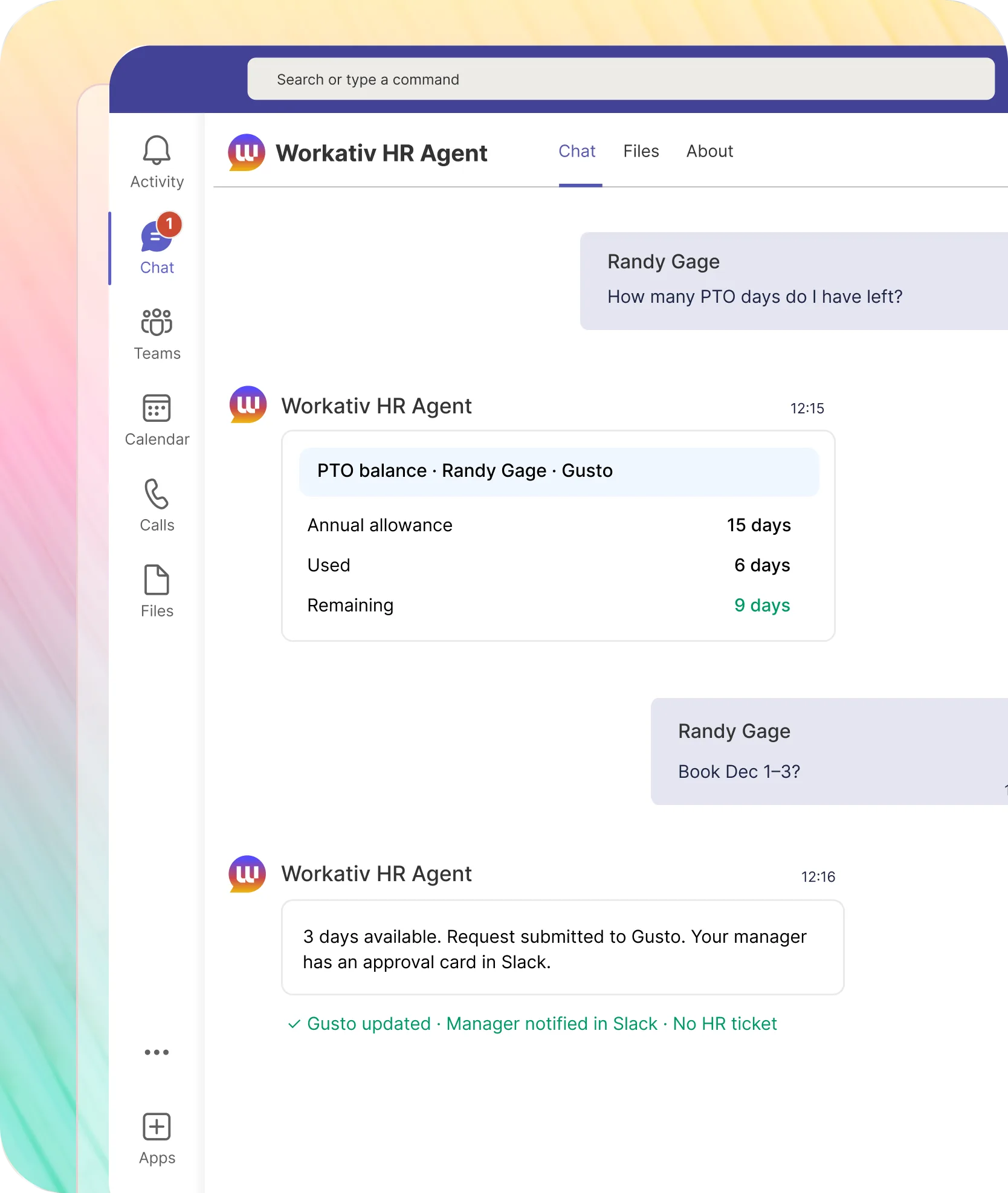
PTO balance from Gusto in seconds. Request submitted and approved all in Slack.

Live PTO balance pulled from Gusto
Leave request submitted through Gusto's time-off workflow
Manager approves in Slack Gusto record updated on approval
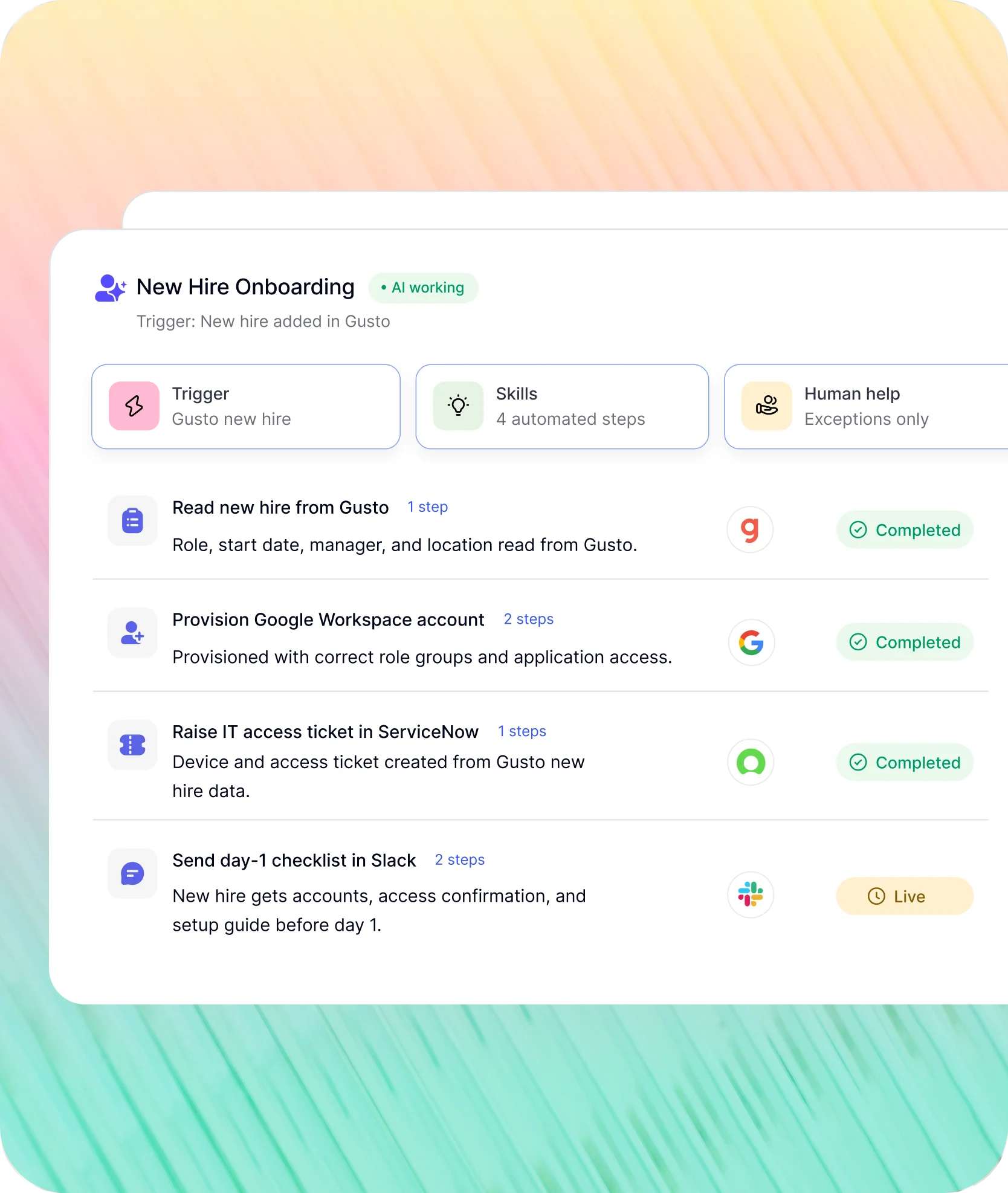
Gusto events trigger workflows across every connected system. No one coordinates manually.
Gusto fires the event. Workativ handles Google Workspace, ServiceNow, and Slack. Set it up once.
New hire added in Gusto. Workspace access, IT ticket, day-1 checklist no manual step.
Triggered by new hire event in Gusto no manual kickoff
Google Workspace or Microsoft 365 account provisioned
New hire has their day-1 checklist waiting in Slack before their first day
GoTo cut HR queries by 80% by connecting its HRIS to Workativ in Slack.
“ Our AI Bot Orion has become a critical enabler of employee self‑service. The quality of responses is fast, comprehensive, and highly reliable, allowing employees to find accurate answers without needing to escalate to HR or IT. What really sets Workativ apart is the visibility into question trends, resolution rates, and where AI is genuinely reducing operational workload. ”

Susan Treadway
Vice President, HR Operations

Connect Gusto to Slack in three steps. No HR team required.
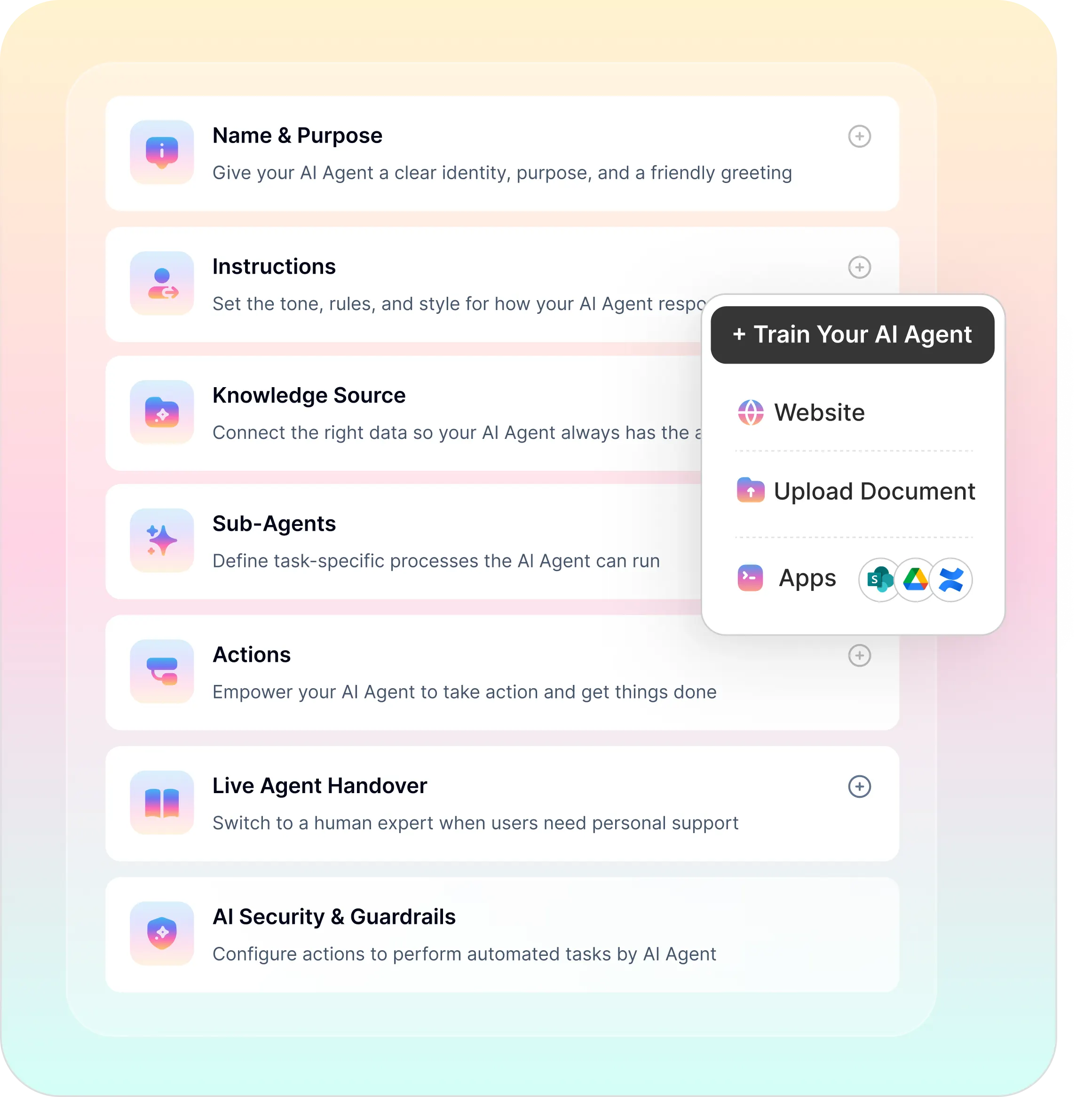
Built for small teams without an HR department. Gusto stays your system of record.
A no-code builder, agentic RAG, workflow automation, and security no implementation project required.
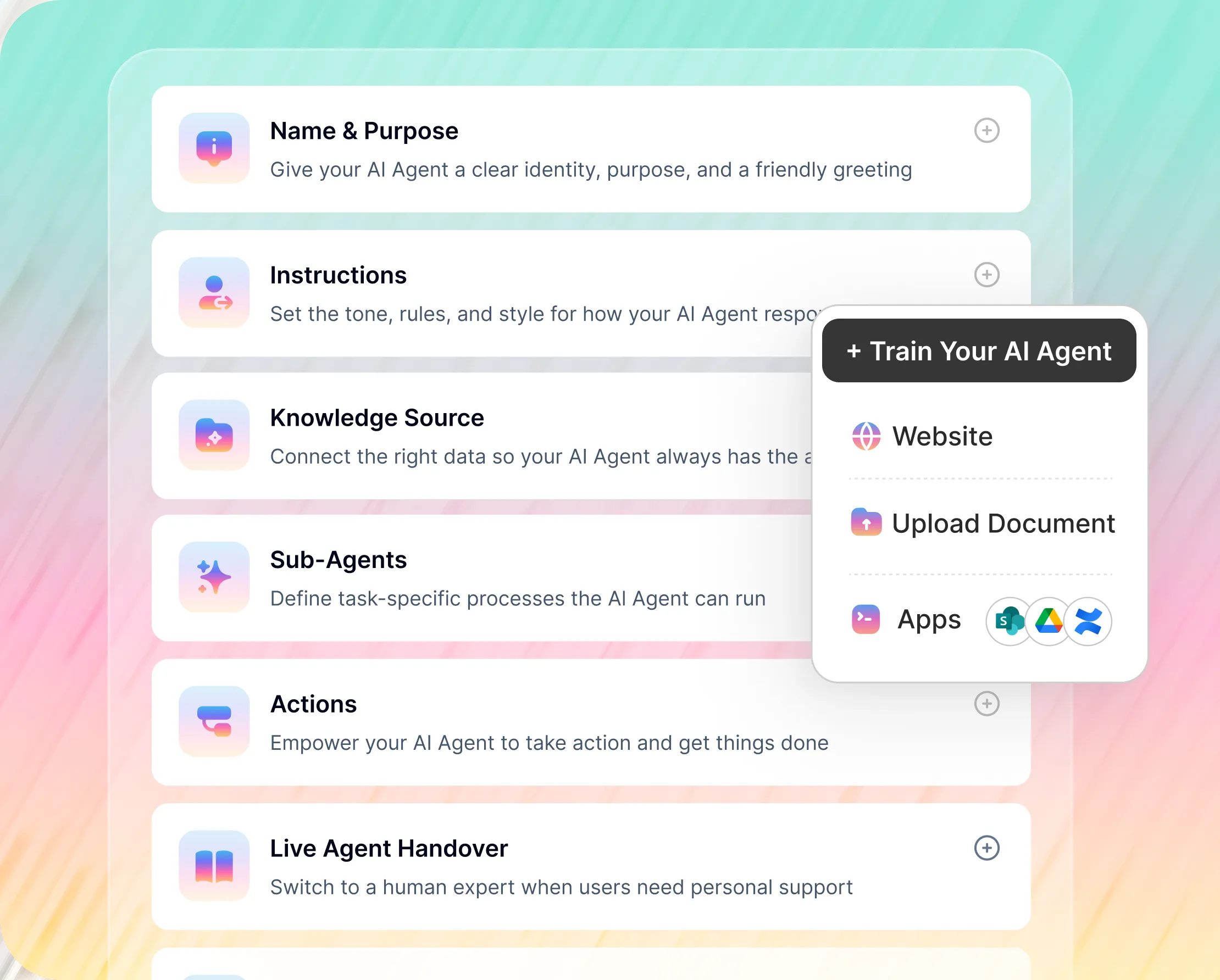
No-Code Gusto AI Agent Builder
Gusto PTO, payslip, personal updates, and expenses all configured point-and-click
Live handover to a person when a request needs judgment
Gusto permissions set by the founder or office manager no consultant needed
Gusto has real AI. Here's where Workativ fits alongside Gus and Cofounder.
Gus answers owner and admin questions. Cofounder executes payroll tasks with approval. Workativ handles the employee side self-service in Slack and extends into systems Gusto doesn't reach.
What matters to you |  |  |  |
|---|---|---|---|
Built for |  | The owner or admin | The owner or admin |
Where it's available | | Gusto platform, ChatGPT, Claude, Slack (read-only) | Gusto platform |
Employees submit PTO in Slack | |  | |
Employees update their own records | | | |
Runs payroll / pulls reports | | | |
Cross-system automation | | | |

When Gus and Cofounder are enough: You're the owner and just need payroll questions answered or routine payroll tasks executed with your approval that's exactly what they're built for.
When to add Workativ: Your employees ask questions in Slack and expect to act on the answer submit a PTO request, update their address without going to Gusto directly. Workativ, Gus, and Cofounder run alongside each other Gusto stays your system of record.
Gusto plus every system your small team works across.
One Gusto AI agent in Slack PTO, pay, expenses, and onboarding workflows coordinated across Gusto and every connected system.


'/%3e%3cpath%20d='M7.53747%209.7499L4.18595%209.72912C3.89511%209.72912%203.66314%209.49022%203.66314%209.20285C3.66314%209.08859%203.70122%208.98126%203.76701%208.89124L8.69389%202.30244C10.2589%203.46925%2010.5809%205.68513%209.41059%207.2501L7.53747%209.7499Z'%20fill='url(%23paint1_linear_217_318)'/%3e%3cdefs%3e%3clinearGradient%20id='paint0_linear_217_318'%20x1='7.3717'%20y1='1.41211'%20x2='9.07645'%20y2='11.0799'%20gradientUnits='userSpaceOnUse'%3e%3cstop%20stop-color='%239DC9FC'/%3e%3cstop%20offset='0.6866'%20stop-color='white'/%3e%3c/linearGradient%3e%3clinearGradient%20id='paint1_linear_217_318'%20x1='9.68512'%20y1='1.62241'%20x2='6.91576'%20y2='7.45173'%20gradientUnits='userSpaceOnUse'%3e%3cstop%20stop-color='%239DC9FC'/%3e%3cstop%20offset='0.7152'%20stop-color='white'/%3e%3c/linearGradient%3e%3c/defs%3e%3c/svg%3e)


%20--%3e%3csvg%20version='1.1'%20id='Layer_1'%20xmlns='http://www.w3.org/2000/svg'%20xmlns:xlink='http://www.w3.org/1999/xlink'%20x='0px'%20y='0px'%20viewBox='0%200%20512%20512'%20style='enable-background:new%200%200%20512%20512;'%20xml:space='preserve'%3e%3cstyle%20type='text/css'%3e%20.st0{fill:%23F7F7F7;}%20.st1{fill:%2328E4C3;}%20.st2{fill:url(%23SVGID_1_);}%20.st3{fill:url(%23SVGID_2_);}%20%3c/style%3e%3ccircle%20class='st0'%20cx='256'%20cy='256'%20r='245.5'/%3e%3cg%3e%3cg%3e%3cpath%20class='st1'%20d='M304.7,405.6'/%3e%3c/g%3e%3c/g%3e%3cg%3e%3cg%3e%3cpath%20class='st1'%20d='M305.8,353'/%3e%3c/g%3e%3c/g%3e%3clinearGradient%20id='SVGID_1_'%20gradientUnits='userSpaceOnUse'%20x1='388.1461'%20y1='99.0534'%20x2='204.4846'%20y2='204.5899'%20gradientTransform='matrix(1%200%200%20-1%200%20514)'%3e%3cstop%20offset='0.18'%20style='stop-color:%230052CC'/%3e%3cstop%20offset='1'%20style='stop-color:%232684FF'/%3e%3c/linearGradient%3e%3cpath%20class='st2'%20d='M119.9,330.3c-3,4.9-6.4,10.7-9.3,15.3c-2.6,4.4-1.2,10,3.1,12.7l60.7,37.4c4.4,2.7,10.1,1.3,12.9-3%20c0,0,0.1-0.1,0.1-0.1c2.4-4.1,5.6-9.3,9-15c24-39.7,48.2-34.8,91.9-14l60.2,28.6c4.7,2.2,10.2,0.2,12.4-4.4c0-0.1,0.1-0.2,0.1-0.3%20l28.9-65.4c2-4.7,0-10.1-4.7-12.2c-12.7-6-38-17.9-60.7-28.9C242.6,241.2,173.1,243.7,119.9,330.3z'/%3e%3clinearGradient%20id='SVGID_2_'%20gradientUnits='userSpaceOnUse'%20x1='613.0198'%20y1='1773.9866'%20x2='429.3116'%20y2='1879.5697'%20gradientTransform='matrix(-1%200%200%201%20736.83%20-1676.71)'%3e%3cstop%20offset='0.18'%20style='stop-color:%230052CC'/%3e%3cstop%20offset='1'%20style='stop-color:%232684FF'/%3e%3c/linearGradient%3e%3cpath%20class='st3'%20d='M392.1,181.9c3-4.9,6.4-10.7,9.3-15.3c2.6-4.4,1.2-10-3.1-12.7l-60.7-37.4c-4.3-2.9-10.1-1.7-13,2.5%20c-0.1,0.2-0.2,0.4-0.3,0.6c-2.4,4.1-5.6,9.3-9,15c-24,39.7-48.2,34.8-91.9,14l-60-28.5c-4.7-2.2-10.2-0.2-12.4,4.4%20c0,0.1-0.1,0.2-0.1,0.3L122,190.2c-2,4.7,0,10.1,4.7,12.2c12.7,6,38,17.9,60.7,28.9C269.4,271,338.9,268.4,392.1,181.9z'/%3e%3c/svg%3e)



%20--%3e%3csvg%20version='1.1'%20id='Layer_1'%20xmlns='http://www.w3.org/2000/svg'%20xmlns:xlink='http://www.w3.org/1999/xlink'%20x='0px'%20y='0px'%20viewBox='0%200%20512%20512'%20style='enable-background:new%200%200%20512%20512;'%20xml:space='preserve'%3e%3cstyle%20type='text/css'%3e%20.st0{fill:%23EB3C00;}%20.st1{fill:%23FFFFFF;}%20%3c/style%3e%3ccircle%20class='st0'%20cx='256'%20cy='256'%20r='245.5'/%3e%3cpath%20class='st1'%20d='M152.2,332.7v-152L286.7,131l73.1,23.4V359l-73.1,22L152.2,332.7l134.4,16.2V171.9L199,192.4v119.8L152.2,332.7%20z'/%3e%3c/svg%3e)

'%3e%3cpath%20d='M1.86774%200H2.41284C2.55325%200.0357914%202.8438%200.0814543%202.96023%200.144319C3.57556%200.476574%204.24389%200.994086%204.78094%201.44029C4.90785%201.49857%205.14031%201.69076%205.26616%201.78501L6.30254%202.56565L9.23874%204.76784L9.98605%205.32579C10.1165%205.42327%2010.3896%205.61784%2010.4874%205.73305C10.5933%205.62723%2010.7819%205.49083%2010.9035%205.39513C11.2293%205.13895%2011.5711%204.89897%2011.9015%204.64888L14.841%202.43616C15.2641%202.11793%2015.808%201.74101%2016.2059%201.4114C16.7548%201.01773%2017.2984%200.503308%2017.8952%200.193124C18.0888%200.0925009%2018.3311%200.0707975%2018.4996%200.00453492L18.511%200H19.1089C19.2716%200.0419345%2019.4446%200.0664859%2019.6017%200.126337C20.3949%200.428494%2020.8251%201.03647%2020.9795%201.84719V4.05546L17.6977%206.51872L16.7256%207.24655C16.6175%207.32813%2016.3229%207.56223%2016.2176%207.62326L16.2116%207.64067C16.0556%207.74125%2015.7554%207.98423%2015.5914%208.10717L14.2347%209.12565C12.9949%2010.0567%2011.7226%2010.9908%2010.4942%2011.9326C10.3311%2011.8196%2010.1521%2011.6753%209.99028%2011.5543L8.91562%2010.7499L6.14505%208.67116C5.6887%208.32244%205.22946%207.97753%204.76737%207.63644L4.76105%207.62385C4.64747%207.54843%204.4662%207.40207%204.35254%207.31617L3.58531%206.74057L0.993507%204.79937C0.666643%204.55579%200.329975%204.28777%200%204.0539V1.89895C0.0211067%201.8406%200.034732%201.7287%200.0477586%201.66355C0.195443%200.924862%200.778193%200.297181%201.50398%200.095359C1.61897%200.0633797%201.74239%200.0411929%201.85419%200.00451034L1.86774%200Z'%20fill='%23EB4337'/%3e%3cpath%20d='M18.5112%200H19.109C19.2718%200.0419345%2019.4448%200.0664859%2019.6018%200.126337C20.395%200.428494%2020.8252%201.03647%2020.9797%201.8472V4.05546L17.6978%206.51872L16.7258%207.24655C16.6176%207.32813%2016.3231%207.56223%2016.2177%207.62326C16.2065%207.10816%2016.2151%206.56484%2016.215%206.04638L16.2148%203.13227L16.2154%201.98927C16.2154%201.85241%2016.2236%201.52684%2016.2061%201.4114C16.755%201.01773%2017.2986%200.503308%2017.8953%200.193124C18.089%200.0925009%2018.3312%200.0707975%2018.4998%200.00453492L18.5112%200Z'%20fill='%23FCBC03'/%3e%3cpath%20d='M1.86774%200H2.41284C2.55325%200.0357914%202.8438%200.0814543%202.96023%200.144319C3.57556%200.476574%204.24389%200.994086%204.78094%201.44029C4.75802%201.55136%204.76536%201.81314%204.76577%201.93571L4.7683%202.76769L4.76727%206.06197L4.76854%207.06889C4.76879%207.22294%204.77708%207.48131%204.76105%207.62385C4.64746%207.54843%204.4662%207.40207%204.35254%207.31617L3.58531%206.74057L0.993506%204.79937C0.666643%204.5558%200.329975%204.28777%200%204.0539V1.89895C0.0211067%201.8406%200.034732%201.7287%200.0477586%201.66355C0.195443%200.924862%200.778193%200.297181%201.50398%200.095359C1.61897%200.0633798%201.74239%200.0411929%201.85419%200.00451034L1.86774%200Z'%20fill='%23C62220'/%3e%3cpath%20d='M0%204.05371C0.329975%204.28758%200.666643%204.5556%200.993507%204.79918L3.58531%206.74038L4.35254%207.31598C4.4662%207.40188%204.64747%207.54824%204.76105%207.62365L4.76737%207.63625C4.79294%207.81891%204.78411%208.19988%204.78406%208.39833L4.78312%209.71796L4.78339%2014.2476C4.7834%2014.4489%204.8101%2015.6601%204.76016%2015.7263C4.75851%2015.7284%204.75656%2015.7304%204.75498%2015.7326C4.75244%2015.7361%204.75024%2015.74%204.74778%2015.7435C4.7463%2015.7457%204.74469%2015.7477%204.74315%2015.7498H1.23433C1.02953%2015.6658%200.870008%2015.6564%200.656526%2015.5145C0.258114%2015.2497%200.102217%2014.9456%200%2014.4978V4.05371Z'%20fill='%234185F5'/%3e%3cpath%20d='M20.9794%204.05566V14.5025C20.828%2015.1172%2020.5387%2015.5356%2019.8875%2015.6981C19.8377%2015.7104%2019.7443%2015.7302%2019.7008%2015.7502H16.235C16.1758%2015.6436%2016.1987%2013.9178%2016.1987%2013.683L16.199%2010.2145L16.1984%208.51668C16.1982%208.31838%2016.1872%207.81396%2016.2115%207.64088L16.2175%207.62347C16.3228%207.56244%2016.6174%207.32834%2016.7255%207.24676L17.6976%206.51892L20.9794%204.05566Z'%20fill='%2333A953'/%3e%3c/g%3e%3cdefs%3e%3cclipPath%20id='clip0_1380_1288'%3e%3crect%20width='20.9795'%20height='15.75'%20fill='white'/%3e%3c/clipPath%3e%3c/defs%3e%3c/svg%3e)
%20--%3e%3csvg%20version='1.1'%20id='Layer_1'%20xmlns='http://www.w3.org/2000/svg'%20xmlns:xlink='http://www.w3.org/1999/xlink'%20x='0px'%20y='0px'%20viewBox='0%200%20512%20512'%20style='enable-background:new%200%200%20512%20512;'%20xml:space='preserve'%3e%3cstyle%20type='text/css'%3e%20.st0{fill:%230062FF;}%20.st1{fill:%23FFFFFF;}%20%3c/style%3e%3ccircle%20class='st0'%20cx='256'%20cy='256'%20r='245.5'/%3e%3cpath%20class='st1'%20d='M256,162.5l-91,58.2l91,58.2l-91,58.2l-91-59.1l91-58.2l-91-57.3l91-58.2L256,162.5z%20M164.1,355.5l91-58.2%20l91,58.2l-91,58.2L164.1,355.5z%20M256,278.1l91-58.2l-91-57.3l91-58.2l91,58.2l-91,58.2l91,58.2l-91,58.2L256,278.1z'/%3e%3c/svg%3e)


Enterprise-grade security. For HR data that matters.

Gusto AI agent
for your HR help desk.
80% of HR queries handled without HR involvement. Onboarding running from Gusto events.
Frequently asked questions
Gusto AI agent frequently asked questions
What is a Gusto AI agent?
A Gusto AI agent connects to your Gusto account and lets employees check PTO balances, submit leave requests, access payslips, update personal details, and get HR policy answers all in Slack, without logging into Gusto. Gusto's own AI tools, Gus and Cofounder, are built for the business owner and admin: they answer payroll questions, run reports, and execute payroll tasks with approval. Workativ's Gusto AI agent is built for the employee it submits requests through Gusto, updates records, routes manager approvals in Slack, and coordinates connected systems like Google Workspace and ServiceNow from a single Gusto trigger. It runs alongside Gus and Cofounder rather than replacing them Gusto stays your system of record either way.
How is Workativ different from Gus, Gusto's AI assistant?
Gus is Gusto's AI assistant, available in the Gusto platform plus ChatGPT, Claude, and Slack. It answers payroll and HR questions for the business owner or admin explaining compliance rules, running off-cycle payroll, pulling reports. Gusto's own documentation confirms the Slack integration is read-only and admin-facing: employees cannot submit a time-off request or update their own details through it. Workativ is built for the employee side: it answers questions and takes action submitting leave requests, updating personal details directly in Slack. Workativ and Gus serve different users and run alongside each other.
How is Workativ different from Gusto's Cofounder AI agent?
Cofounder is Gusto's more advanced agentic AI, built to execute payroll runs, pay contractors, and pull custom reports with owner approval before each action. It operates on the business's payroll and financial workflows, not employee HR self-service. Workativ operates on the employee side of Gusto PTO requests, personal updates, policy Q&A, and onboarding coordination and extends those workflows into systems outside Gusto, such as Okta, ServiceNow, and Jira, which neither Gus nor Cofounder reach.
Does Gusto's Slack integration let employees submit requests?
No. Gusto's Slack integration, built on the Gusto MCP, is read-only and admin-only. Admins can ask questions like who has a birthday coming up or what a recent payroll cost, but employees cannot submit a PTO request, check their own balance, or update their details through it. If an employee wants to take an action in Gusto today, they have to go to the Gusto platform directly. Workativ closes that gap by giving employees a self-service AI agent in the same Slack workspace.
How does Workativ integrate with Gusto?
Workativ connects to Gusto via its public API, using OAuth2 authentication and role-based access controls. Once connected, Workativ reads from Gusto employee records, PTO balances, payslips, policy documents and writes back: submitting leave requests, updating personal details, and triggering onboarding workflows. No developer required.
Can the Gusto AI agent submit PTO requests in Slack?
Yes. Employee asks in Slack. Workativ reads their live PTO balance from Gusto, confirms availability, and submits the request through Gusto's time-off workflow. Manager receives an approval card in Slack one tap to approve. Gusto record updated. Employee confirmed in the same thread. This is the specific action Gusto's own Slack integration doesn't support for employees today.
What HR workflows can Workativ automate with Gusto?
Workativ automates three core Gusto workflows: new hire onboarding (a Gusto new hire event triggers Google Workspace or Microsoft 365 account setup, an IT access ticket in ServiceNow or Jira, and a day-1 Slack checklist), leave approval (employee requests in Slack, manager approves in Slack, Gusto record updated), and offboarding (a Gusto termination event triggers access revocation across connected apps and an equipment return notification in Slack).
Is Workativ suitable for the small teams that typically use Gusto?
Yes. Gusto's core customer base is companies with roughly 5 to 50 employees, often without a dedicated HR person. Workativ is built for that profile: a no-code setup a founder or office manager can configure directly, published pricing with no custom quote, and deployment in 3 to 5 days. Most Gusto customers set it up without involving a developer or an HR specialist.
Can the Gusto AI agent handle employee onboarding?
Yes. When Gusto adds a new hire, Workativ triggers the onboarding workflow: provisions the identity account in Google Workspace or Microsoft 365, raises an IT access ticket in ServiceNow or Jira for anything outside those platforms, and delivers a day-1 checklist to the new hire in Slack before they start. Gusto remains the system of record. The workflow is set up once and runs for every new hire.
Can employees update personal details in Gusto from Slack?
Yes. Employees update their address, emergency contacts, or bank details by asking in Slack. Workativ verifies their identity and writes the change directly to Gusto. No portal login. No HR ticket. Gusto record updated and confirmed in Slack.
Is Gusto employee data secure with Workativ?
Yes. Workativ connects to Gusto using OAuth2 authentication with role-based access controls. The AI agent only reads and writes what it has been explicitly permitted to access. Gusto data is never used to train models. PII is masked in all conversation logs. Every Gusto action is logged to an immutable audit trail. Workativ is SOC 2 Type II, ISO 27001, GDPR, and HIPAA compliant.
How long does Gusto AI agent deployment take?
3 to 5 days for standard HR self-service PTO requests, pay queries, personal updates, HR policy Q&A. No developer required. No implementation project. Workativ's no-code platform connects Gusto, configures the AI agent, and deploys it to Slack. Most small teams using Gusto go live without hiring outside help.