
How to Build and Train AI Agents: Complete Guide 2026
Complete guide to building and training AI agents. Learn architecture, training methods, deployment strategies, evaluation metrics & best practices for enterprise AI.


TL;DR
AI agents go beyond traditional chatbots by combining reasoning, context understanding, and action execution to complete tasks end to end.

Building effective AI agents depends heavily on high-quality data, proper training, and continuous optimization to maintain accuracy and relevance.
A structured approach—defining purpose, preparing data, training models, and designing workflows—is essential for successful deployment.
No-code AI agent platforms like Workativ simplify development, enabling teams to build, deploy, and scale agents quickly without heavy engineering effort.
Building an AI agent involves more than selecting an AI model. A successful agent must understand user requests, retrieve accurate information, and take actions across connected business applications. Whether you're creating an AI agent for HR support, IT helpdesk automation, or customer service, the goal is to build a system that can complete tasks reliably, not just generate responses.
The process starts with defining the agent's purpose, preparing business knowledge, choosing the right AI model, and configuring its instructions and workflows. Technologies such as retrieval-augmented generation (RAG) help agents access company-specific information, while integrations and orchestration enable them to execute multi-step tasks.
You can build a custom AI agent using developer frameworks or simplify the process with a no-code AI agent buildersuch as Workativ. If your agent needs reliable answers from company documents, connecting it to an enterprise Knowledge AI platform is an important part of the setup.
Below, we'll walk through seven practical steps to build, train, test, and deploy an AI agent for real business workflows.
What is an AI agent?
AI agents are advanced computer programs that simulate natural language between a machine and a human to help people find answers to their questions and perform tasks end-to-end until the goal is achieved.
Unlike traditional AI systems that work only once when prompted, AI agents exhibit human-like agency to make decisions through sub-processes of complex tasks and execute them no matter how the scenario changes.
For example, if an AI agent handles an email campaign for marketing operations, it can follow end-to-end. In the funnel, if any email receives a business query, it eventually learns to answer all questions and, if need be, can schedule a meeting with the sales.
There are many types of AI agents, including assistive and autonomous agents. Assistive agents follow predefined rules to provide answers and help employees with specific tasks. Autonomous agents can work without human intervention to understand and respond to employee queries. An AI agent builder can help you create the custom AI agents of your choice.
Training is key to building powerful and valuable artificial intelligence agents for complex, multi-step tasks. Let's explore the several steps involved in training and creating an AI agent.
What are the fundamentals of building and training AI agents?
At the core, data is essential to building and training an AI agent, which involves teaching AI agents to understand and respond to human language while being trained to remain relevant and meaningful to user queries. Data stays at the heart of training no matter what AI models you choose. Here’s how data works for a variety of AI concepts.
Machine learning : AI systems with machine learning can adapt and learn without being programmed. When trained, this type of AI uses algorithms to ingest historical data, identify patterns, and eventually learn to make decisions and respond. The more data ML in AI agents ingests, the better it gets in responding.
Natural language processing : When interactions occur between a computer and a human, NLP, a significant part of AI technology, helps decipher human language and improve understanding, intent, and context. For AI agents, NLP ensures that human language is expressed meaningfully.
Data labeling : Imagine finding a sack in a room full of identical sacks. It is undoubtedly a tough job if you are to find a sack without a label on it. Data labeling or tagging is essential to AI training, where AI trainers annotate data metadata or tags for raw data to help AI agents or systems identify the correct information stack.
Data labels categorize raw data into topics, tag parts of speech in a sentence, and determine the sentiment of a query. Various meaningful labels help AI agents to understand and respond to user queries in a meaningful way.
SKIP THE CUSTOM BUILD
Why build from scratch when Workativ's no-code AI Agent Studio, deploys in days - not months?
What Are the Essential Steps for Building an AI Agent?
Building an AI agent involves combining language models, business knowledge, and automated workflows to perform tasks with minimal manual intervention. However, choosing an AI model is only the beginning. The real challenge is ensuring the agent understands requests, retrieves the right information, executes actions securely, and delivers reliable results.
For example, an HR AI agent may need to answer policy questions, check employee leave balances, and initiate onboarding tasks. An IT support agent may need to troubleshoot common issues, create service tickets, and automate approved access requests. Each requires different knowledge sources, integrations, and execution rules.
Whether you're building from scratch or using a no-code AI agent builder, the following seven steps will help you move from an initial idea to a working AI agent.
Step 1: Define the Purpose and Scope of Your AI Agent
Before building an AI agent, identify the business problem it needs to solve. This determines which capabilities, knowledge sources, and integrations you'll need throughout development.
Identify the use case
Start with a specific, repeatable business task rather than trying to automate an entire department.
Common AI agent use cases include:
HR support: Answer employee policy questions, retrieve leave balances, and assist with onboarding.
IT service desk: Resolve common technical issues, reset passwords, and manage support tickets.
Customer support: Track orders, answer product questions, and handle service requests.
Business operations: Coordinate approvals, retrieve information, and automate recurring workflows.
Define responsibilities and success criteria
Establish what the AI agent can do independently, what requires approval, and when it should involve a human.
For example, an HR support agent might be expected to answer routine policy questions accurately and create support tickets for unresolved issues. Its success can be measured through response accuracy, task completion, and escalation rates.
Key takeaway: Start with one clearly defined use case, establish measurable goals, and expand the agent's responsibilities once it performs reliably.
Step 2: Collect and Prepare Data for AI Agent Training
An AI agent needs relevant, reliable information to understand business-specific questions and deliver accurate answers. Poor-quality knowledge can lead to outdated responses, incorrect decisions, and unnecessary escalations.
Identify reliable knowledge sources
Depending on your use case, training and grounding sources may include:
Company documents: Employee handbooks, HR policies, SOPs, and product guides.
Knowledge bases: FAQs, troubleshooting articles, and internal support documentation.
Historical support data: Previous customer or employee requests that can help identify common scenarios.
Business applications: HRIS, CRM, and ITSM systems that provide current information through integrations.
Clean and organize the information
Before connecting the data, remove outdated content, resolve conflicting information, check document permissions, and organize knowledge by department, topic, or effective date.
For example, an HR AI agent answering benefits questions should retrieve information from the correct benefits plan and policy year rather than relying on outdated documents.
Use RAG for company-specific knowledge
Retrieval-augmented generation (RAG) allows an AI agent to retrieve relevant information from approved company sources when generating an answer. Unlike fine-tuning, RAG doesn't require the underlying model to be retrained whenever business documents change.
For businesses working with frequently updated policies and documentation, connecting an agent to enterprise Knowledge AI can simplify how business knowledge is accessed and maintained.
Key takeaway: Reliable AI agent performance begins with trusted, well-organized knowledge—not simply larger volumes of training data.
Step 3: Choose the Right AI Model, Framework, and Tools
The next step is selecting the technology your AI agent will use to understand requests, access knowledge, and perform actions.
Select a large language model
Most enterprise AI agents use pre-trained LLMs rather than developing a foundation model from scratch. Models from providers such as OpenAI, Anthropic, and Google can support natural-language understanding, reasoning, and tool use.
Evaluate models based on response quality, latency, cost, supported capabilities, and your organization's security requirements.
Choose the development framework
The framework determines how your agent connects with tools, manages state, and coordinates execution.
Common development options include:
LangChain: Connects language models with tools, APIs, and retrieval systems.
LangGraph: Supports stateful, multi-step agent workflows.
LlamaIndex: Helps applications retrieve and work with external knowledge.
CrewAI: Supports collaboration between specialized agents.
Decide between custom development and no-code platforms
Custom frameworks offer greater architectural flexibility but require engineering, infrastructure management, and ongoing maintenance.
No-code and low-code platforms can simplify agent configuration, knowledge integration, workflow automation, and deployment for business teams.
Key takeaway: Choose the simplest technology stack that can reliably support your agent's tasks, integrations, and security requirements.
Step 4: Train and Configure Your AI Agent
Training an AI agent doesn't always involve changing the underlying AI model. For many business applications, it means configuring an existing LLM with clear instructions, approved knowledge, examples, and tools.
Define the agent's instructions and behavior
Specify the agent's role, supported tasks, communication style, response boundaries, and escalation conditions.
For example, an HR agent can be instructed to answer questions using approved company policies, request clarification when information is missing, and escalate sensitive requests to authorized HR personnel.
Connect the agent to business knowledge
Use RAG to provide relevant company documents and information during conversations. This helps the agent answer questions based on approved business sources instead of relying solely on its general training.
Configure tools and actions
Connect the agent with applications so it can retrieve information or complete approved tasks.
An HR AI agent, for example, might use integrations to check leave balances, create employee support tickets, or retrieve onboarding status.
Test with realistic prompts
Evaluate the agent using real-world questions such as:
"How many paid leave days do I have?"
"Can you check the status of my onboarding request?"
"What happens if my leave request is rejected?"
"Can you create a support ticket for my payroll issue?"
Review whether it retrieves the right information, collects missing details, uses authorized actions, and handles exceptions correctly.
Key takeaway: Effective AI agent training combines clear instructions, trusted knowledge, configured actions, and continuous testing.
Step 5: Design Conversational Workflows and Automate Actions
Once your AI agent can understand requests and retrieve information, configure how it should complete tasks across connected systems.
Build end-to-end workflows
A conversational workflow defines how the agent moves from understanding a user's request to executing an approved action.
For example, consider an employee requesting leave through an HR AI agent:
The employee submits a leave request in Microsoft Teams.
The agent retrieves the employee's leave balance from the HR system.
It validates the request against the applicable policy.
It submits the request and routes it for manager approval when required.
Once approved, the connected system records the leave and the agent confirms the outcome.
Configure approvals and human escalation
Not every request should be automated without oversight. Define when the agent must request approval, ask for additional information, or escalate to a human.
For example, sensitive payroll changes, access removals, and policy exceptions may require additional authorization.
This approach is especially useful in HR workflow automation, where AI agents coordinate tasks across employees, managers, and enterprise applications.
Key takeaway: A capable AI agent should complete approved workflows, handle exceptions, and know when human involvement is required.
Step 6: Test and Validate AI Agent Performance
Before deploying an AI agent, verify that it can provide accurate information, perform actions successfully, and handle unexpected scenarios.
Test common and complex scenarios
Evaluate how the agent responds to straightforward questions, ambiguous requests, missing information, unavailable integrations, and restricted actions.
Testing should also confirm that the agent doesn't invent unsupported answers or execute tasks without appropriate authorization.
Measure AI agent performance
Focus on metrics that reflect actual business outcomes:
Response accuracy: Does the agent provide correct, relevant, and grounded answers?
Task completion rate: Can it complete the requested process successfully?
Tool execution success: Do connected actions return the intended results?
Escalation rate: Does it involve human support when appropriate?
Response latency: How quickly does it answer questions and execute tasks?
Review failed interactions to identify whether the problem comes from unclear instructions, missing knowledge, integration errors, or inadequate workflow controls.
Key takeaway: Validate both answer quality and task execution before allowing an AI agent to operate in production.
Step 7: Deploy, Monitor, and Continuously Improve Your AI Agent
Once your AI agent passes testing, deploy it through the channels where employees or customers already interact.
Choose the right deployment channel
Depending on your use case, AI agents can operate through Microsoft Teams, Slack, company intranets, websites, or other supported communication channels.
For example, an HR support agent deployed in Microsoft Teams allows employees to ask policy questions and initiate requests without switching between multiple applications.
Start with a controlled pilot
Launch the agent with a small user group before expanding deployment. Gather feedback, review failed requests, and verify that integrations work correctly under real operating conditions.
Monitor and optimize performance
Track task completion, response accuracy, escalations, user satisfaction, and workflow failures. Update instructions, knowledge sources, and action configurations as business requirements change.
Key takeaway: Successful AI agent deployment requires ongoing evaluation and improvement, not just an initial launch.
THERE'S AN EASIER WAY
Workativ handles training, workflows, and deployment in one no-code platform - no ML setup required.
No-code · Deep integrations · Deploy in minutes
Go live in days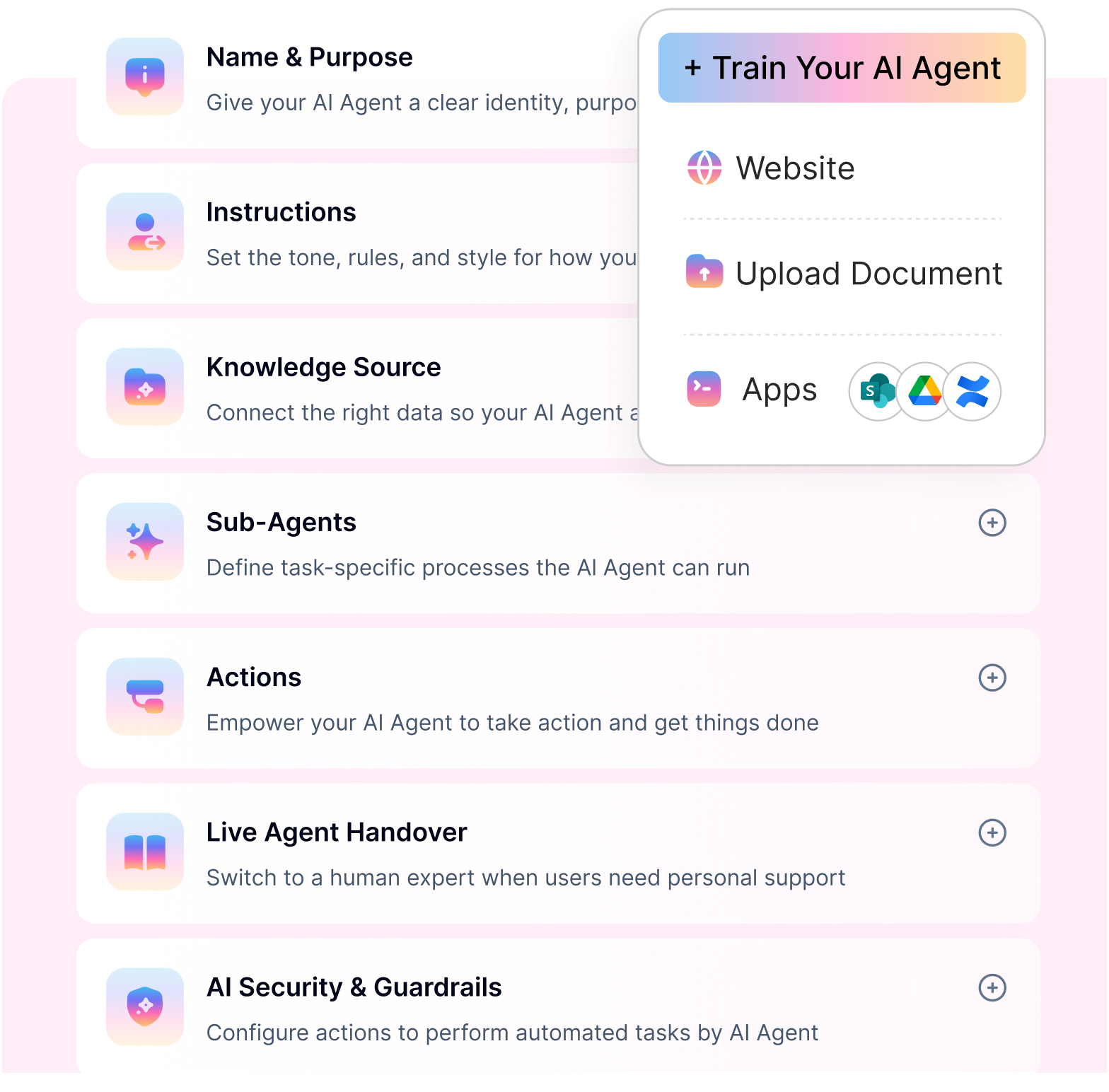
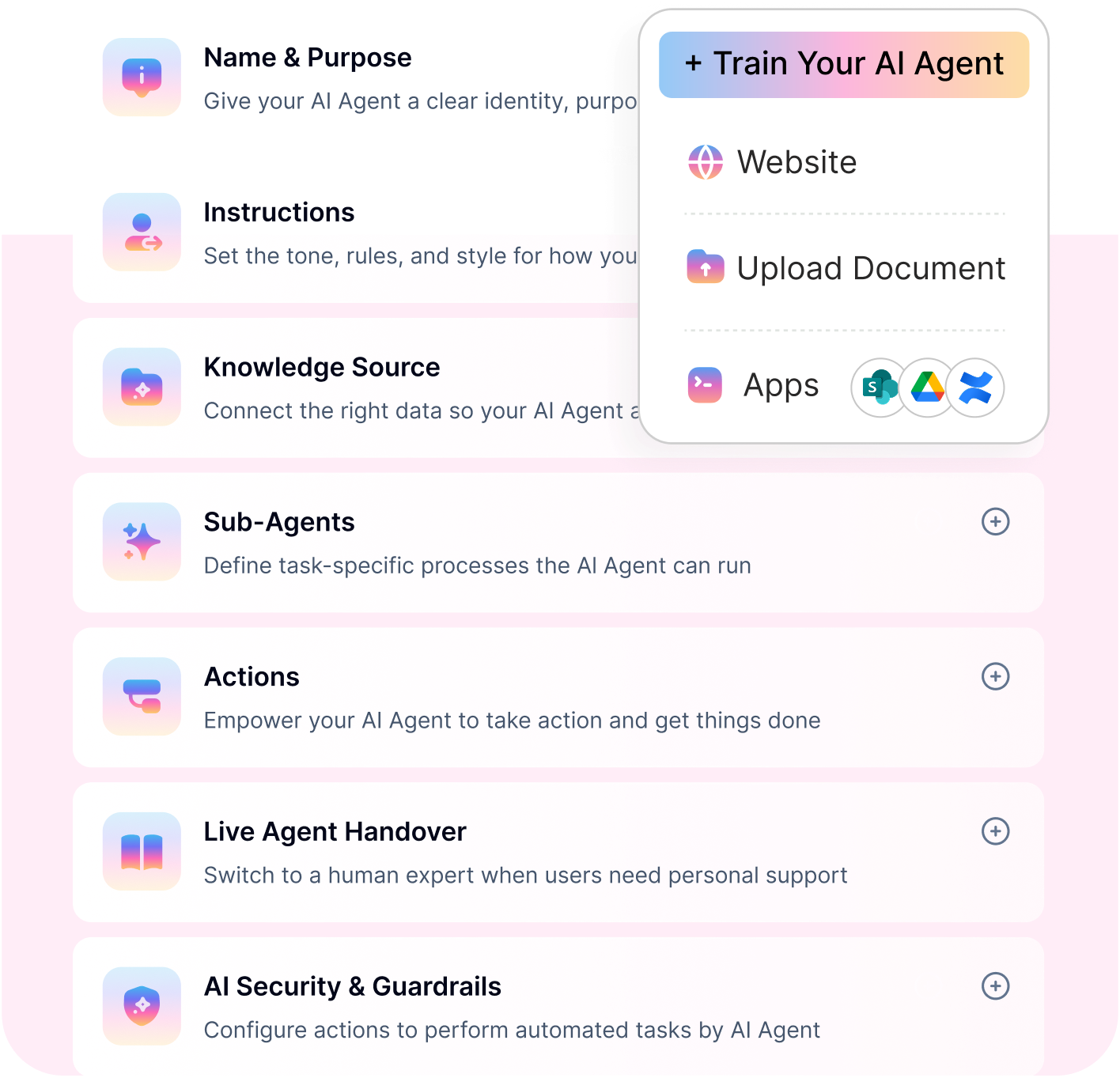
How to Evaluate AI Agent Performance
Building an AI agent is only the first step. Its real value depends on how accurately it responds, executes tasks, and handles unexpected requests. For example, an HR AI agent may answer leave policy questions correctly but fail to submit a leave request through the connected HR system.
Key metrics to measure AI agent performance
Metric | What it measures |
|---|---|
Task completion rate | Percentage of requests successfully completed |
Response accuracy | Correctness of answers against trusted knowledge |
Tool execution success | Reliability of connected actions and integrations |
Escalation rate | Requests transferred to human support |
Response latency | Time taken to respond or complete tasks |
How to improve AI agent performance
Regularly review failed conversations, inaccurate answers, and incomplete workflows. Identify whether the problem comes from outdated knowledge, unclear instructions, integration failures, or missing permissions.
For deeper guidance, explore our AI agent evaluation guide to learn how to assess and improve agent performance.
AI Agent Architecture Explained
AI agent architecture combines language models, memory, business knowledge, tools, and orchestration to understand requests and execute tasks. Unlike standalone LLMs, AI agents can interact with connected applications and complete multi-step workflows.
What are the five core components of AI agent architecture?
1. LLM and reasoning: Understands user requests, interprets context, and determines appropriate next steps.
2. Memory and context: Maintains relevant conversation history and information needed to complete ongoing tasks.
3. Knowledge and tools: Retrieves information from trusted sources using RAG and performs actions through connected applications. Solutions such as Workativ Knowledge AI support access to enterprise knowledge.
4. Orchestration: Coordinates tool execution, workflow conditions, approvals, and retries.
5. Guardrails and human oversight: Enforces permissions, validates actions, and transfers sensitive requests for human approval.
How does AI agent architecture work in practice?
Consider an employee onboarding agent. It retrieves new-hire information, checks onboarding requirements, creates IT provisioning requests, and sends notifications. The orchestration layer coordinates these actions, while security controls ensure the agent operates within authorized boundaries.
This architecture allows AI agents to go beyond answering questions and automate business processes across multiple applications.
Build vs. Buy: Custom AI Agent Development vs. No-Code Platforms
Should you build an AI agent from scratch or use a no-code platform? The right approach depends on your technical resources, customization requirements, deployment timeline, and ongoing maintenance needs.
Custom AI Agent Development vs. No-Code Platforms
Factor | Custom development | No-code platform |
|---|---|---|
Deployment | Requires development and testing | Faster setup with existing capabilities |
Technical skills | AI engineers and developers | Business and IT teams |
Customization | Greater architectural control | Configurable within platform capabilities |
Integrations | Custom API development | Prebuilt and configurable integrations |
Maintenance | Managed internally | Platform infrastructure managed by vendor |
Costs | Engineering, infrastructure, and model usage | Subscription, usage, and implementation |
Which Approach Should You Choose?
Choose custom development when you need proprietary models, highly specialized workflows, or complete control over infrastructure.
Choose a no-code AI agent platform when your priority is automating business workflows, connecting enterprise knowledge, and deploying agents without extensive engineering.
For HR, IT, and employee support use cases, Workativ AI Agent Studio provides a no-code approach to configuring agents, connecting applications, and automating workflows.
Ultimately, choose the approach that balances flexibility, reliability, security, and long-term maintenance costs.
5. Design and build the conversational workflows
Once you learn that your AI agents have undergone a perfect training process and perform accurately, it is time to define how they should interact with users. Building and training custom AI agents must adhere to a business's personalized needs. So, they must respond beyond FAQs and react as the scenario demands. So, be ready for scenarios your AI agent can encounter and handle queries.
FAQs : Allow your AI agents to fetch information from knowledge bases and respond to users directly.
Third-party data retrieval : Integrate with business systems through APIs or connectors so that your AI agents can fetch data from third-party systems and answer user queries.
Agents hands-off : Set a fallback scenario so that AI agents can quickly transfer a call to a human agent if they do not have enough answers.
6. Test and validate AI agents
Once you have built your AI agent, you must test and validate if it performs as expected. AI agents must be flexible with FAQs, including custom or unique questions. Document all the scenarios stated in the above section and test them. Other than this, check if your AI agent can handle user errors. If your AI agents can simulate all scenarios, it is confirmed that your AI agent bot can handle conversational workflows and provide correct answers.
Testing and validation also include preventing hallucinations. To optimize AI agents’ performance, you must do the following:
Tweak prompts : Correct or tweak system prompts to ensure that AI agents can achieve accuracy for human language.
Fetch only verified data : Ensure that your AI agents only fetch data from verified sources instead of making responses independently.
7. Deploy and monitor the AI agent
Once everything is ready, you can deploy your AI agent in a live environment and monitor user interaction.
There are various platforms, such as your company website, business applications, and chatbot, to deploy your bot. For example, if you want to deploy it into your chatbot system. With Workativ, you can deploy your AI agent into MS Teams, Slack, or a website widget.
After you deploy the AI agent, monitor its performance to ensure it meets your user expectations. The best way to monitor and implement updates to the AI agent is to ask for user feedback. By collecting and implementing feedback, you can ensure that AI agents can adapt over time, improve, and meet user expectations.
What's the best way to build an AI agent?
The best way to build an AI agent depends on your business goals, technical expertise, and the tasks you want to automate. While custom development offers greater flexibility, no-code AI agent platforms provide a simpler approach for businesses looking to automate HR, IT, and customer support workflows.
With Workativ, businesses can configure AI agents, connect enterprise knowledge, automate tasks, and deploy agents across communication channels without building everything from scratch.
How to build an AI agent using Workativ
1. Configure your AI agent: Define its purpose, instructions, personality, and supported tasks.
2. Connect business knowledge: Add company documents, FAQs, policies, and knowledge sources to support accurate answers.
3. Integrate applications: Connect HRIS, ITSM, and other enterprise systems to retrieve information and execute actions.
4. Test and optimize: Validate responses, workflow execution, and exception handling before deployment.
5. Deploy your agent: Make the agent available through Microsoft Teams, Slack, or web chat and monitor its performance.
Why choose a no-code AI agent platform?
No-code platforms help businesses reduce development complexity while maintaining the flexibility to configure workflows, integrations, and agent behavior.
For example, HR teams can build AI agents that answer employee questions and automate onboarding activities. Explore how an AI agent for HR onboarding coordinates employee information, IT provisioning, approvals, and notifications across connected systems.
Whether you choose custom development or no-code tools, focus on building an agent that can complete tasks securely, accurately, and reliably.
Common AI agent training mistakes to avoid
Building an AI agent is only half the process. Inaccurate knowledge, poor testing, and missing security controls can affect its performance even after deployment. Here are six mistakes to avoid.
1. Using outdated or inaccurate training data
Conflicting or outdated documents can lead to incorrect answers. Use verified knowledge sources, remove duplicate information, and regularly update business data.
2. Testing only simple scenarios
Testing only straightforward questions doesn't reflect actual usage. Include ambiguous requests, missing information, and integration failures to evaluate real-world performance.
3. Skipping human escalation
AI agents cannot resolve every request independently. Configure fallback rules, approval checkpoints, and human handoffs for complex or sensitive situations.
4. Ignoring AI hallucination risks
AI models may generate unsupported information. Use retrieval-augmented generation (RAG), trusted knowledge sources, and output validation to improve response reliability.
5. Providing excessive system access
Unrestricted application access creates security risks. Apply role-based permissions, least-privilege access, and approvals for sensitive actions.
6. Neglecting continuous optimization
Agent performance can change as business information and workflows evolve. Monitor response accuracy, task completion, failed actions, and escalation rates to identify improvements.
Key takeaway: Effective AI agent training requires reliable knowledge, realistic testing, strong guardrails, and ongoing performance monitoring.
Build Smarter AI Agents That Deliver Real Results
Building and training an AI agent isn't just about choosing the right model. Success depends on reliable knowledge, clear instructions, connected workflows, and continuous improvement. Whether you're automating HR support, IT requests, or customer service, the goal is to create AI agents that go beyond answering questions to completing tasks accurately and securely.
With Workativ's no-code AI Agent Studio, businesses can simplify agent development, connect enterprise applications, and automate workflows without the complexity of building everything from scratch.
Ready to turn your AI agent ideas into action? Book a demo with Workativ and discover how you can build, train, and deploy AI agents for your business.
FAQs
1. What is the difference between an AI agent and an LLM?
A large language model (LLM) understands and generates text, while an AI agent combines an LLM with knowledge, tools, and workflows to execute tasks. For example, an LLM can explain how to reset a password, whereas an AI agent can initiate an authorized password-reset workflow through connected applications.
2. Do I need coding skills to build an AI agent in 2026?
No. You can build AI agents without extensive coding using no-code platforms that support model configuration, knowledge integration, and workflow automation. However, custom AI agent development may require programming skills for specialized integrations, infrastructure, and complex business logic.
3. What is agentic AI orchestration?
Agentic AI orchestration coordinates how AI agents execute multi-step tasks. It manages tool selection, workflow execution, approvals, retries, and human intervention when needed. This enables AI agents to automate business processes such as employee onboarding, IT ticket resolution, and approval workflows.
4. How can I train an AI agent using my company's data?
You can train or configure an AI agent with company-specific knowledge using retrieval-augmented generation (RAG). Connect approved documents, FAQs, policies, and knowledge bases so the agent can retrieve relevant information when responding. This approach helps keep answers current without repeatedly fine-tuning the underlying language model.
5. What is the best way to build an AI agent without coding?
The most practical approach is to use a no-code AI agent builder that supports knowledge integration, business application connections, workflow automation, and testing. Platforms such as Workativ allow businesses to configure and deploy AI agents for HR, IT, and employee support without building the entire system from scratch.
6. How do I know if my AI agent is performing accurately?
Evaluate your AI agent using response accuracy, task completion rate, tool execution success, escalation rate, and response time. Test it with realistic user requests, incomplete information, and unexpected scenarios. Regular monitoring helps identify knowledge gaps, failed workflows, and opportunities for improvement.


About the Author
Deepa Majumder

Senior content writer
Deepa Majumder is a writer who nails the art of crafting bespoke thought leadership articles to help business leaders tap into rich insights in their journey of organization-wide digital transformation. Over the years, she has dedicatedly engaged herself in the process of continuous learning and development across business continuity management and organizational resilience.
Her pieces intricately highlight the best ways to transform employee and customer experience. When not writing, she spends time on leisure activities.
Auto-resolve 60% of Your Employee
Queries With AI Agents & Automation
- No credit card required
- Setup in minutes
- Cancel Anytime
