
Langdock Reviews 2026: Pricing, Pros, Cons & Best Alt
Explore Langdock's AI capabilities, enterprise features, pricing structure, implementation requirements, and alternatives.


TL;DR
Langdock is strong for secure internal AI and knowledge access, but falls short when it comes to executing workflows end to end.

Its per-seat pricing model increases costs with scale, making ROI harder to measure as adoption grows across teams.
While useful for AI experimentation and productivity, it still relies on humans to complete most operational tasks.
Platforms like Workativ stand out by combining AI reasoning with action execution, enabling real automation and measurable outcomes.
Langdock has emerged as a popular choice for enterprises looking to deploy secure, private AI assistants across internal teams. With a strong emphasis on EU data residency, governance, and controlled AI usage, it is often shortlisted for knowledge access, internal productivity, and compliance-driven use cases.
At the same time, buyer reviews and real-world evaluations highlight important trade-offs. Organizations evaluating Langdock frequently raise questions around pricing predictability, limited automation beyond Q&A, and how clearly AI spend translates into measurable outcomes. This blog takes a closer look at Langdock reviews, outlines its practical pros and cons, and explores when teams begin considering alternatives such as Workativ.
What is Langdock?
Langdock is an enterprise AI platform that provides secure, private ChatGPT-style assistants for internal teams. It is commonly used by organizations that want to enable AI-powered access to knowledge and productivity while maintaining strong governance, particularly in EU-regulated environments.
Langdock focuses on internal Q&A and information retrieval rather than end-to-end task execution. As a result, it is often chosen by enterprises starting their internal AI adoption journey, before moving on to platforms that deliver deeper automation and measurable operational outcomes
How does Langdock work?
Langdock works as a secure internal AI layer that sits on top of an organization’s existing knowledge and documents, allowing employees to interact with that information through a private, governed AI assistant.
Once deployed, Langdock is connected to internal sources such as documents, policies, and knowledge bases. Employees can then ask questions in natural language, and the AI retrieves relevant information to generate contextual answers. Access is controlled through administrative permissions, ensuring that users only see content they are authorized to view. This governance-first design is a key reason Langdock is often adopted by EU-based and compliance-focused organizations.
Langdock does not execute workflows or take actions across enterprise systems. Instead, it supports employees by surfacing information and guidance, leaving the actual task execution, such as creating tickets, updating systems, or approving requests, to humans. In practice, this makes Langdock well-suited for knowledge discovery and internal productivity, but less well-suited for teams looking to automate end-to-end operational processes.
Langdock reviews: What users are saying in 2026
Reviews of Langdock in 2026 reflect a fairly consistent theme: buyers appreciate the platform’s strong security posture and governance-first approach, but expectations around automation and ROI are more mixed.
What users like about Langdock,
Strong accessibility with an EU-first focus

Reviews of Langdock highlight how easy it is to create custom AI assistants without deep technical expertise. Users value the flexibility to switch between AI models and the responsive, hands-on support from the founding team. Simple knowledge ingestion and EU-based hosting are often cited as key reasons for choosing Langdock over more generic AI tools.
Fast model access with strong compliance foundations

Langdock focuses on its plug-and-play approach to AI model integration, making it easy to adopt new models as they are released. Users value the platform’s model-agnostic design, which allows teams to stay current in a fast-moving AI landscape without added complexity.
Strong GDPR compliance and SOC 2 Type II certification are also frequently highlighted, helping build trust around data security and enterprise readiness.
Noticeable productivity gains and responsive support

Reviews of Langdock often highlight tangible productivity improvements, with some users reporting significant daily time savings. The user experience is described as intuitive and smooth, helping teams integrate AI naturally into their workflows.
Fast, hands-on customer support and a steady pace of feature releases further contribute to positive sentiment around the platform.
Strong admin controls and enterprise-ready configuration

Reviews of Langdock frequently point to its ease of integration with internal data sources and the responsiveness of its team. Administrators value the built-in analytics that help track adoption across the organization, as well as the level of customization available during large-scale rollouts.
Features like usage limits for expensive models and configurable links to internal documentation are often highlighted as especially useful when deploying Langdock to hundreds of employees. Where users struggle
Slight learning curve for advanced features

Some users note that while Langdock is easy to get started with, its more advanced features can take time to fully understand. New users may need additional onboarding or guidance to make the most of the platform’s deeper configuration and administrative controls.
Still maturing as a platform

Some reviews point out that Langdock is still in its early stages, with a few smaller features not yet fully built out. While users generally view the roadmap positively, they note that certain capabilities are expected to evolve as the product matures through future updates.
Change management and user adoption challenges

It is observed that Langdock across an organization can be harder than expected, especially when teams are already comfortable with tools like ChatGPT. Users point out that familiarity with existing interfaces creates resistance to change, even when the new platform offers stronger governance or capabilities.
This feedback is less about product limitations and more about the time and effort required to shift habits during large-scale internal adoption.
SOUND FAMILIAR?
Langdock answers questions. Someone still has to do the work. That's not automation - that's AI chat.
No per-seat fees · No token add-ons · Single click training
See a Quick Demo
Key features that define Langdock
Langdock is defined by its focus on secure, governed AI access for internal teams. At its core, the platform enables organizations to deploy private AI assistants connected to internal documents and data sources, allowing employees to retrieve knowledge and ask questions in natural language without exposing sensitive information. Let us see some of its powerful features.
Chat: Model-agnostic AI chat that can be safely used by everyone in the organization, with centralized governance and access controls.
Workflows: AI-powered workflows that help automate repetitive tasks and standardize internal processes.
Agents: Custom AI agents built for recurring tasks, enabling consistent and role-specific assistance across teams.
Integrations: Native integrations with existing tools and data sources, making it easier to bring AI into current workflows.
API: A flexible API that allows teams to embed Langdock’s AI capabilities into internal applications and systems.
Knowledge management: Connect internal documents and knowledge bases so AI assistants can provide contextual, company-specific answers.
Model flexibility: Support for multiple leading AI models, allowing teams to choose the right model for each use case.
Governance and access control: Administrative controls to manage permissions, usage limits, and model availability across the organization.
Analytics and adoption tracking: Insights into usage and adoption to help administrators understand how AI is being used internally.
Strengths and limitations of Langdock
Langdock is often evaluated for its governance-first approach to internal AI, but like most enterprise platforms, it comes with clear advantages and trade-offs.
Pros:
Enterprise-grade security and compliance: Langdock is well-positioned for EU-based and regulated organizations, with a clear focus on GDPR compliance, data residency, and secure internal AI use.
Model-agnostic AI access: Teams can switch between different AI models as needed, avoiding vendor lock-in and allowing flexibility as new models emerge.
Strong governance and admin controls: Administrators can manage access, usage limits, and model availability, making large-scale internal rollouts easier to control.
Easy internal adoption: Connecting knowledge sources and deploying AI assistants across teams is generally straightforward, reducing friction during early rollout.
Cons:
Limited end-to-end automation: Langdock primarily functions as an AI assistant, so workflows still depend on humans to execute actions.
ROI can be difficult to quantify: Pricing scales with user base and usage, which makes it harder to tie AI spend directly to measurable outcomes.
Not built for operational resolution: The platform is less suited for resolving IT, HR, or operational requests without human involvement.
The feature set is still evolving: As a growing platform, some advanced capabilities and integrations are still maturing, which may limit complex use cases today.
Popular use cases of Langdock
Langdock is primarily adopted by enterprises looking to introduce AI in a controlled and secure way. Its use cases tend to focus on internal productivity, knowledge access, and the adoption of governed AI rather than on customer-facing automation or operational execution.
Internal knowledge search and Q&A: Langdock is commonly used to help employees quickly find answers from internal documents, policies, and manuals through natural language queries.
Employee self-service assistance: Teams use Langdock to reduce repetitive questions by providing AI-driven responses for common internal queries across departments.
Governed AI access for enterprises: Organizations adopt Langdock as a safe way to roll out generative AI internally while maintaining control over data access, models, and usage.
Productivity support for knowledge workers: Langdock helps knowledge-intensive teams summarize documents, explore internal information, and accelerate research tasks.
AI experimentation in regulated environments: Many enterprises use Langdock as an entry point for experimenting with AI under strict security, compliance, and governance requirements.
From Answers to Execution
Langdock stops at the answer. Workativ finishes the job tickets, approvals, and requests, all automated.
Langdock pricing and plans 2026: what you need to know before you buy
Langdock does not publish simple, fixed pricing tiers on its website. Instead, pricing is designed for mid-to-large enterprises and is typically customized based on usage, number of users, and deployment scope. This makes it important for buyers to understand how costs are constructed before committing.
Below is a clear, segment-by-segment breakdown of what drives Langdock pricing in 2026 and why it often appears more costly than alternatives like Workativ.
How Langdock pricing works
Langdock follows a per-seat, enterprise-oriented pricing model, with additional costs layered on for AI usage and workflows. While this aligns with its positioning as a secure internal AI platform, it is also the main reason Langdock is often perceived as expensive at scale.
Below is a clear, figure-based breakdown of Langdock’s 2026 pricing and why it can be more costly than alternatives like Workativ.
Business plan: €25 per user per month
Langdock’s primary paid plan costs €25 per user per month (excluding VAT). This fee applies to every employee granted access to the platform and includes core capabilities such as AI chat, custom agents, governance controls, and enterprise authentication (SSO, SAML, SCIM).
Why this adds up quickly:
As AI adoption expands beyond a small pilot group, costs grow linearly with headcount. Even users who interact with AI occasionally incur the full monthly seat cost, making large rollouts expensive.
AI model usage is charged separately
The per-seat price does not include AI model usage. All model consumption is billed separately based on tokens, typically at the underlying model provider’s rate plus a Langdock markup.
Why this matters: Organizations pay once for access (seats) and again for usage (tokens), creating two independent cost drivers that can grow simultaneously.
Workflow pricing on top of seats : Langdock’s workflow capabilities are priced as add-on packages at the workspace level. Higher workflow volumes require higher-priced monthly packages, and unused runs do not roll over.
Why does this increase cost? : Workflow automation is not bundled into the per-seat fee, so teams that want AI-driven workflows pay extra on top of user licenses.
Enterprise plan: custom pricing
For large organizations, Langdock offers a custom enterprise plan with negotiated pricing. These contracts often include minimum user counts, annual commitments, and enterprise onboarding requirements.
Even phased rollouts or limited initial use cases may require committing to enterprise-level pricing before full value is realized.
Why per-seat pricing makes Langdock costly compared to Workativ
Langdock’s pricing is tied primarily to who can access AI, not to what AI actually accomplishes. Costs increase as more employees are enabled, regardless of whether AI reduces tickets, resolves requests, or automates workflows.
Workativ takes a different approach by aligning pricing to usage and execution outcomes. Spend scales with tasks handled and workflows completed rather than employee count, making it easier to forecast costs and demonstrate ROI as adoption grows.
Langdock’s pricing works best for organizations that prioritize secure AI access and governance across a controlled user base. However, for teams focused on automation, operational efficiency, and predictable ROI, per-seat pricing can become expensive quickly, especially when compared to outcome-aligned platforms like Workativ.
Best alternative to Langdock: How Workativ compares
When teams move beyond internal AI experimentation and start prioritizing execution, automation, and measurable ROI, Workativ is often evaluated as a strong alternative to Langdock. The difference comes down to how each platform is designed to be used in day-to-day operations.
Ease of use for business teams : Langdock is intuitive for knowledge access and AI chat, but advanced configuration often requires deeper onboarding. Workativ is built for operational teams, with no-code setup that allows IT and HR teams to configure agents and workflows without relying on developers.
Customization and control : Langdock focuses on governed AI access with limited workflow flexibility. Workativ offers deeper customization through configurable AI agents, workflows, and actions that can be tailored to specific IT, HR, or operations use cases.
Pricing philosophy and cost structure : Langdock uses per-seat pricing with usage and workflow costs, which can scale quickly as adoption grows. In contrast, Workativ uses a session-based, usage-driven pricing model with clear published plans that scale with actual AI interactions and resolved requests. Costs are easier to forecast and align with real usage, making it ideal for teams that want costs tied to outcomes rather than total workforce size. Workativ offers the following tiered pricing plans, which are billed monthly or annually.
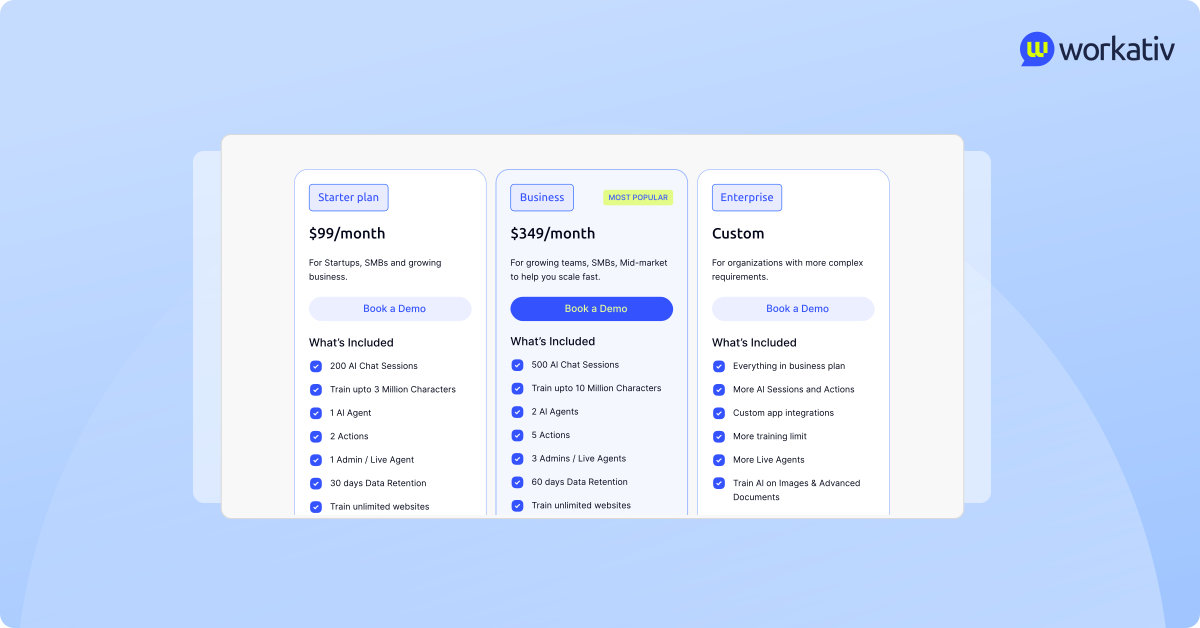
Starter plan ($99) – Includes a generous number of sessions with core employee support capabilities, ideal for pilots and early adoption.
Business plan ($349/month) – Comes with higher session limits, advanced integrations, analytics, and automation features needed for production use.
Enterprise plan (custom) – Designed for large organizations requiring compliance, RBAC, SSO, and tailored deployment, without forcing unnecessary long-term lock-ins. The key difference lies in how costs scale. Workativ prices by sessions, not employee count or opaque enterprise bundles. This means organizations pay based on actual usage rather than total workforce size, avoiding inflated costs when only a subset of employees actively use the AI agent.
AI precision and task execution : Langdock excels at answering questions and surfacing knowledge, but execution remains manual. Workativ is designed to resolve requests end to end, combining AI understanding with actions that complete tasks across enterprise systems.
Speed to deploy : Langdock rollouts typically focus on gradual internal adoption. Workativ is built for faster time to value, with production-ready agents often deployed in weeks rather than months.
Zero development effort : Langdock does not require heavy development, but deeper integrations and workflows may still need technical effort. Workativ is fully no-code, allowing teams to build, iterate, and scale automation without engineering involvement.
Built for operational outcomes : Langdock is best suited for internal AI assistance and governed experimentation. Workativ is purpose-built for operational resolution, helping teams reduce tickets, automate workflows, and clearly measure ROI. Langdock is a solid choice for secure internal AI access. Workativ stands out when the goal is to move beyond assistance into execution—delivering faster deployment, greater customization, flexible pricing, and AI that actually completes work rather than just advising on it.
Head-to-head comparison: Langdock vs Workativ
Category | Langdock | Workativ |
Primary focus | Internal AI assistant for knowledge access | End-to-end AI automation and request resolution |
Ease of use | Easy for AI chat; advanced setup takes time | Built for business teams with full no-code setup |
Customization | Limited to assistants and governed access | Deep customization with workflows, actions, and agents |
Pricing model | Per-seat pricing plus usage and add-ons | Usage-aligned pricing tied to outcomes |
Cost scalability | Increases with employee count | Scales with work completed, not headcount |
READY TO MOVE FROM CHAT TO RESOLUTION?
See how Workativ handles what Langdock leaves to your team - live, in your own environment.
Personalized demo · No commitment · No per-seat fees
See Workativ AI in actionSelecting the right AI platform for employee support and beyond
Both Langdock and Workativ address different stages of an organization’s AI journey. Langdock is a solid option for enterprises that want to introduce AI in a controlled way, focusing on secure knowledge access, internal Q&A, and governance-first adoption.
However, as teams move beyond experimentation and start expecting AI to reduce workload, resolve requests, and deliver measurable ROI, Workativ clearly stands out. Its no-code setup, faster time to deploy, outcome-aligned pricing, and ability to execute workflows end to end make it better suited for IT, HR, and operations teams looking for real operational impact—not just AI assistance.
Book a demo with Workativ and explore how you can launch AI-powered employee support in weeks, not months without enterprise friction or unpredictable costs.
FAQs
Is Langdock suitable for automation use cases?
Langdock is primarily designed for internal AI assistance and knowledge access. While it supports workflows at a basic level, most actions still require human execution, which limits end-to-end automation.
Why do teams consider Workativ over Langdock?
Teams often evaluate Workativ when they need AI to resolve requests, execute workflows, and deliver measurable ROI rather than only providing answers or guidance.
How does pricing differ between Langdock and Workativ?
Langdock uses per-seat pricing with additional usage and workflow costs, which can scale with headcount. Workativ aligns pricing with usage and outcomes, making costs easier to forecast as adoption grows.
Which platform is easier to deploy?
Langdock is relatively easy to set up for AI chat and knowledge access. Workativ typically delivers faster time to value for automation use cases, with no-code deployment in weeks.
Is Workativ suitable for enterprises?
Yes. Workativ is built for enterprise use, offering no-code configuration, deep integrations, security controls, and scalability for IT, HR, and operations teams.
Can Workativ replace internal AI assistants like Langdock?
Workativ can cover AI assistance needs while also going further by executing tasks, automating workflows, and resolving operational requests end to end.
Is Langdock suitable for customer support automation?
Langdock is primarily designed for internal use cases like knowledge access and employee assistance, not for handling customer-facing support workflows.
What type of organizations benefit most from Langdock?
Langdock is best suited for enterprises focused on secure AI adoption, especially those prioritizing governance, compliance, and internal productivity.
What are the limitations of Langdock for IT and HR teams?
It lacks deep workflow automation and action execution, making it less effective for teams looking to reduce tickets or automate operations.
'%3e%3cpath%20d='M11.5732%2031.7068L19.2977%2022.7433L11.5732%2011.5366H17.4664L22.6245%2018.942L29.0522%2011.5366H30.7788L23.4029%2020.0985L31.4127%2031.7086H25.4997L20.1231%2023.9069L13.3197%2031.7068H11.5732ZM16.6519%2012.8366H13.9536L26.354%2030.4462H28.9926L28.8265%2030.1576L16.6519%2012.8366Z'%20fill='%230C0C0C'/%3e%3c/g%3e%3cdefs%3e%3cclipPath%20id='clip0_505_14364'%3e%3crect%20width='19.7681'%20height='20.2432'%20fill='white'%20transform='translate(11.573%2011.5365)'/%3e%3c/clipPath%3e%3c/defs%3e%3c/svg%3e)

'%3e%3cpath%20d='M25.2175%2011.7557L26.9132%2011.911V15.0496C26.0135%2015.1444%2024.1746%2014.7452%2023.5821%2015.5947C23.4908%2015.726%2023.3291%2016.1592%2023.3291%2016.3091V19.002H26.7392L26.3346%2022.5281H23.3291V31.5952H19.707V22.5863L19.649%2022.5281H16.6628V19.002H19.707C19.7813%2017.4024%2019.4664%2015.7042%2020.1132%2014.1986C20.6748%2012.8902%2021.7857%2012.0974%2023.1666%2011.8435L23.7151%2011.7557H25.2183H25.2175Z'%20fill='%230C0C0C'/%3e%3c/g%3e%3cdefs%3e%3cclipPath%20id='clip0_505_14375'%3e%3crect%20width='10.2695'%20height='19.8027'%20fill='white'%20transform='translate(16.658%2011.7567)'/%3e%3c/clipPath%3e%3c/defs%3e%3c/svg%3e)
About the Author
Deepa Majumder

Senior content writer
Deepa Majumder is a writer who nails the art of crafting bespoke thought leadership articles to help business leaders tap into rich insights in their journey of organization-wide digital transformation. Over the years, she has dedicatedly engaged herself in the process of continuous learning and development across business continuity management and organizational resilience.
Her pieces intricately highlight the best ways to transform employee and customer experience. When not writing, she spends time on leisure activities.
Auto-resolve 60% of Your Employee
Queries With AI Agents & Automation
- No credit card required
- Setup in minutes
- Cancel Anytime